YouTube quietly removes upload date sorting, sparking creator backlash
YouTube eliminates sort-by-upload-date function while maintaining date filters, disrupting news discovery workflows for creators and viewers.


YouTube eliminates sort-by-upload-date function while maintaining date filters, disrupting news discovery workflows for creators and viewers.
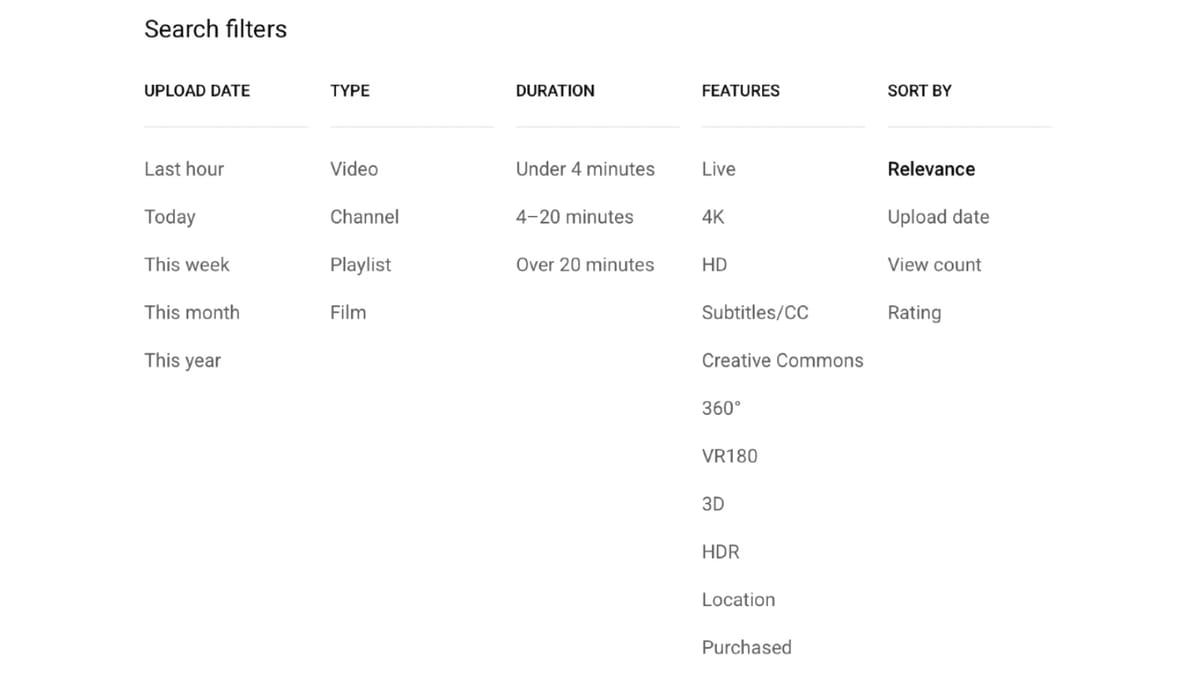
YouTube announced changes to its search filter system on January 9, 2026, removing the ability to sort search results by upload date while retaining date-based filtering options. The modifications, disclosed through the platform's official TeamYouTube community manager Carlos, aim to make search "more effective and intuitive," but the removal of sorting functionality has generated significant criticism from content creators and users who rely on chronological discovery mechanisms.
The announcement detailed three primary changes: introduction of dedicated content type filters including a new Shorts filter, renaming of the "Sort by" menu to "Prioritize," and replacement of "View count" sorting with a "Popularity" filter that evaluates multiple engagement signals beyond raw view numbers. The platform also eliminated two specific filter options: "Upload date - Last hour" and "Sort by rating."
According to the official announcement posted January 9 in YouTube's Help Community, "We've heard your feedback and are improving the search experience by updating our filters to be more effective and intuitive for everyone. Our goal is to give you more effective advanced search tools, ensuring you can find the content you love consistently and efficiently."
The restructured filter menu introduces a dedicated Shorts filter within the "Type" menu, providing users with explicit control over short-form versus long-form video results. This separation addresses ongoing creator concerns about content type mixing in search results, particularly as YouTube has redirected significant home feed real estate toward Shorts content throughout 2025.
The renamed "Prioritize" menu replaces the previous "Sort by" functionality, though the practical implications of this terminology shift remain unclear. YouTube describes the menu as "optimized" but provides limited technical documentation about algorithmic changes underlying the new prioritization system.
The new "Popularity" filter replaces view count sorting, incorporating multiple engagement signals according to YouTube's documentation. "This filter lets you easily find popular videos related to your searches. Our systems evaluate a video's view count and other indicators of relevance, such as watch time, to determine its popularity for that specific search," the announcement stated.
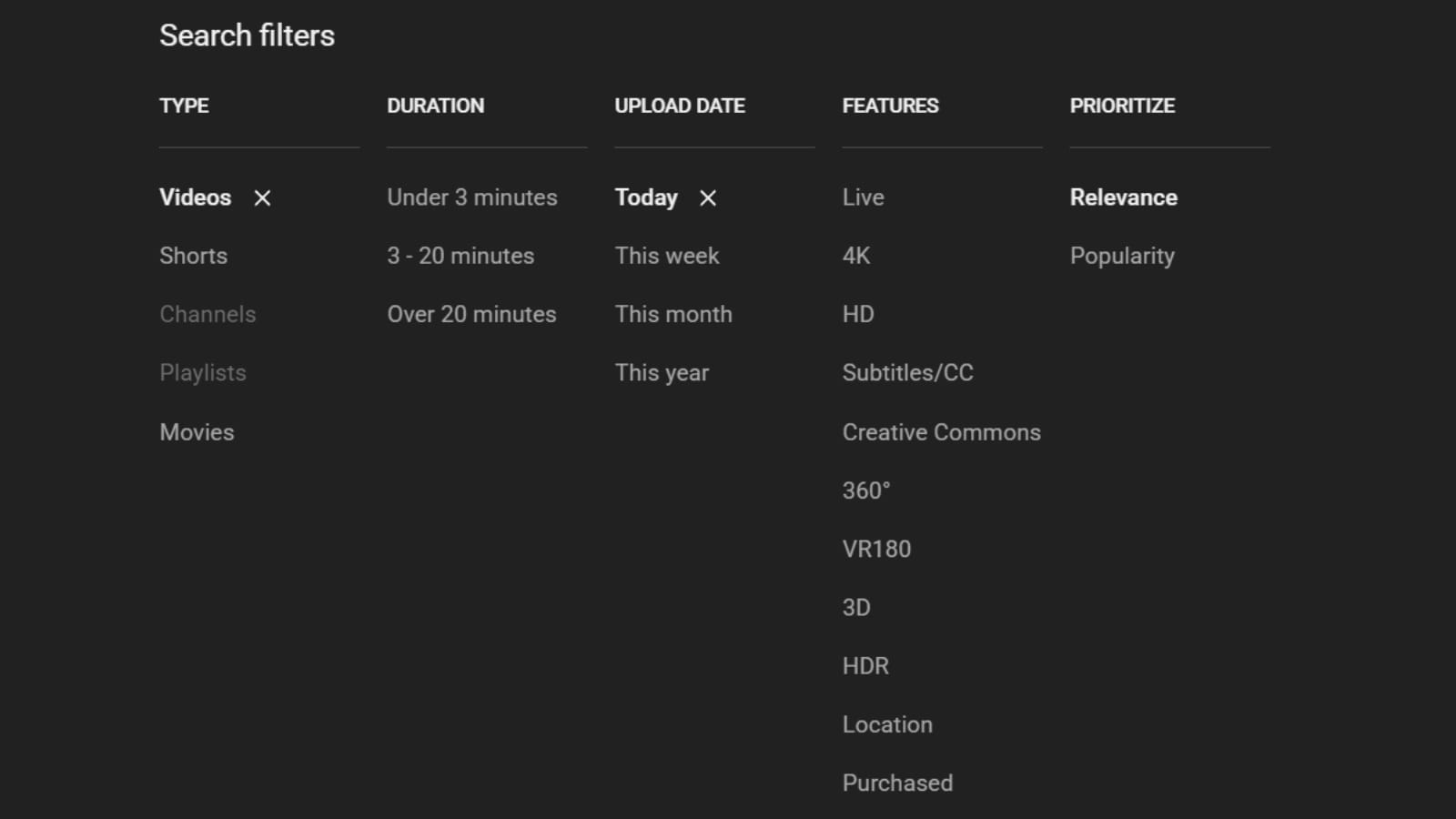
The upload date filters remain available in four temporal categories: Today, This Week, This Month, and This Year. However, users can no longer sort filtered results chronologically, a distinction that has proven consequential for specific use cases.
The removal of sort-by-date functionality represents a fundamental shift in power dynamics between users and platform algorithms. Previously, users could bypass YouTube's recommendation systems entirely by sorting search results chronologically, allowing direct access to the most recent content regardless of algorithmic assessments of quality, relevance, or engagement potential.
The new structure eliminates this user-controlled pathway. Every search result now passes through YouTube's algorithmic filtering, even when users apply temporal filters. Searching for videos uploaded "Today" no longer guarantees chronological presentation; instead, YouTube's systems determine which of today's uploads appear first based on undisclosed relevance and popularity calculations.
This architectural change consolidates Google's control over content visibility. The "Prioritize" menu offers only two options: Relevance and Popularity. Both rely on algorithmic evaluation rather than objective metrics users can independently verify. View counts, which previously allowed users to sort by a transparent metric, have been absorbed into the opaque "Popularity" calculation that also considers watch time and unspecified "indicators of relevance."
The shift affects more than discovery mechanics. It fundamentally alters the relationship between content creators and audiences. Creators can no longer rely on temporal surfacing to reach users actively seeking the newest content on specific topics. Instead, new uploads must immediately generate engagement signals strong enough to trigger algorithmic promotion, or they remain buried beneath older content that has accumulated views and watch time.
For breaking news, product launches, time-sensitive tutorials, and event coverage, this creates systematic disadvantages. A video uploaded five minutes ago about a developing news story competes not on timeliness but on engagement metrics it hasn't had time to accumulate. Users searching for the latest information encounter videos YouTube's algorithms deem "popular" or "relevant" rather than simply the most recent.
The consolidation extends YouTube's broader pattern of replacing user agency with algorithmic curation. The platform's home feed, subscription feed, and now search results all filter content through recommendation systems designed to maximize engagement metrics that serve YouTube's advertising business model. Users retain filtering options for content type, duration, and upload date ranges, but lose the ability to impose their own sorting logic on filtered results.
This matters particularly for topics where algorithmic popularity conflicts with user intent. Niche subjects, emerging creators, controversial topics, and content challenging dominant narratives face structural disadvantages in systems prioritizing popularity metrics. Users seeking such content must now work against algorithmic preferences rather than using chronological sorting to bypass them entirely.
YouTube frames these changes as improvements, but the underlying shift clearly favors platform control over user autonomy. The company determines not just which videos might interest users—the traditional function of recommendation algorithms—but which videos users can easily find even when actively searching for specific content with temporal constraints.
Chris Menahan articulated widespread concerns about the functional implications of removing sort-by-date capabilities. "YouTube has removed the ability to search by upload date. Removing this basic function will make it impossible to find breaking news from small channels with few viewers. Evidently, force-feeding people 'curated' slop is more important than site usability," Menahan wrote on X on January 9.
The distinction between filtering and sorting became central to user criticism. TeamYouTube responded to Menahan's concerns, stating: "You can still use our Upload Date filters (Today, This Week, This Month, or This Year) to find the most recent results within your search. We've only removed the option to sort search results by upload date as a part of this update."
User-contributed context on X challenged YouTube's framing of functional equivalence. "Filtering by 'today' but without the ability to sort does not result in the ability to view the 'most recent' videos as claimed," according to community notes attached to TeamYouTube's response. The note, rated helpful by X users, included a dictionary reference distinguishing filtering from sorting operations.
Brett MacDonald challenged YouTube's characterization directly: "Meaning you removed the ability, fundamentally, to see the most recent uploads. This doublespeak doesn't fly anymore." Creator Mike Doscher described the change as "obfuscation disguised as incompetence," while Dave Kratzy, who uses the handle @Krtzyy, explained practical implications: "I used the sort by date feature almost every day as a creator, especially when trying to find the newest content about a certain game/subject (that VERY often get hidden if they were posted by a small channel). Why do this? Your algorithms are terrible with new niche subjects."
Reid Southen questioned YouTube's product strategy more broadly: "Do you have nothing better to do than follow enshittification to a T? What purpose does it serve to make your platform worse? Why are you removing features? I speak for literally everyone when I say what the fuck are you doing."
TeamYouTube acknowledged creator concerns in a follow-up response to Menahan: "Really appreciate your response, and can see how sorting by upload date is helpful when tracking breaking news. We're sharing this feedback live with our product team."
Buy ads on PPC Land. PPC Land has standard and native ad formats via major DSPs and ad platforms like Google Ads. Via an auction CPM, you can reach industry professionals.
The search filter modifications align with broader YouTube interface changes throughout 2025 that systematically reduce long-form video prominence in favor of Shorts content. Data shared by retention director Mario Joos in December 2025 demonstrated that browse recommendations dropped from six long-form videos per row to just two, redirecting approximately 80% of available slots toward Shorts.
These interface decisions carry economic implications for content creators whose discovery depends on temporal relevance rather than algorithmic amplification. Small channels producing time-sensitive content face structural disadvantages when sort-by-date functionality disappears, as their videos may never accumulate the engagement signals required to trigger "Popularity" sorting algorithms.
YouTube's filtering approach functionally creates content silos organized by time period rather than continuous temporal streams. Users searching for breaking news within "Today" filters must manually page through results to identify the most recent uploads, a workflow substantially more friction-intensive than chronological sorting.
The platform's characterization of these changes as improvements to "effectiveness" and "intuition" conflicts with creator testimonials describing degraded utility for specific use cases. YouTube's Help Center documentation confirms that the "Last hour" filter has been eliminated entirely, removing the most granular temporal filtering option previously available.
The timing of these search modifications coincides with YouTube's ongoing interface redesign efforts announced in October 2025, which introduced cleaner video player controls and custom engagement animations. However, those changes focused on reducing visual clutter rather than eliminating core discovery functionality.
For the marketing community, YouTube's search modifications affect content discovery patterns that determine video performance and advertising inventory value. Videos that cannot surface through chronological discovery mechanisms must rely on algorithmic recommendation systems or external promotion to reach audiences.
The "Popularity" filter's incorporation of watch time alongside view counts suggests prioritization of engagement metrics that benefit longer-form content with higher retention rates. This algorithmic preference potentially disadvantages shorter news-oriented content that generates views without extended watch time, creating systematic discovery barriers for time-sensitive information.
YouTube's 3 million Partner Program creators generating advertising revenue face differentiated impacts based on content types and audience development strategies. Creators producing evergreen content may benefit from popularity-based sorting that surfaces high-performing videos regardless of publication date. News-oriented channels and emerging creators covering trending topics face structural disadvantages when temporal relevance becomes harder to surface.
The platform's characterization of these changes as "streamlining" and "reorganizing" for improved "intuitiveness" frames feature elimination as optimization rather than capability reduction. However, creator responses suggest YouTube's internal definitions of "effectiveness" may not align with user definitions of utility for specific discovery workflows.
The implementation of these changes without apparent testing periods or gradual rollouts suggests confidence in the platform's ability to absorb user criticism without meaningful adoption impacts. YouTube's position as the dominant video platform with approximately 2.7 billion monthly active users provides substantial leverage in product decisions, even when those decisions generate creator backlash.
YouTube's advertising business generated $31.5 billion in revenue during 2023, with substantial portions derived from video discovery through search and recommendation systems. Search filter modifications that alter content surfacing patterns necessarily affect which videos receive impressions and how advertising inventory gets allocated across the platform's creator ecosystem.
The platform has not announced any changes to its advertising targeting capabilities based on these search modifications, though the underlying discovery mechanics affect which content types receive traffic and therefore advertising exposure. Creators whose content relies on breaking news discovery may see reduced organic reach, potentially affecting their advertising revenue and requiring increased investment in external promotion or YouTube's paid promotion tools.
YouTube's announcement emphasized that "Popularity" filter algorithms evaluate relevance indicators beyond view counts but provided limited technical detail about the signals incorporated or how the system prevents manipulation. The platform's history with recommendation algorithms demonstrates ongoing challenges balancing content quality, creator diversity, and advertiser safety requirements.
The elimination of "Sort by rating" alongside upload date sorting removes two user-controlled discovery mechanisms in favor of platform-controlled algorithmic systems. This centralization of discovery mechanisms increases YouTube's control over content surfacing while reducing user agency in navigation workflows.
The platform's Help Center documentation notes that filters underwent "simplification" to remove "options that were not working as expected and were causing user complaints," though YouTube did not specify which complaints drove the elimination of sort-by-date functionality or how the feature was not working as expected.
Creator responses suggest the removed functionality was working as intended for their specific use cases, indicating a disconnect between YouTube's internal performance evaluation and external user utility assessments. The gap between platform characterization and user experience testimonials raises questions about the criteria YouTube employs when evaluating feature effectiveness.
Subscribe PPC Land newsletter ✉️ for similar stories like this one
Subscribe PPC Land newsletter ✉️ for similar stories like this one
Who: YouTube, through its TeamYouTube community manager Carlos, announced the search filter modifications affecting the platform's 2.7 billion monthly active users and 3 million Partner Program creators. Critics including Chris Menahan of InformationLiberation.com and creators using handles @Krtzyy, @BrettAMacDonald, and @Rah@@ responded with concerns about discovery workflow disruption.
What: YouTube eliminated the ability to sort search results by upload date while maintaining temporal filtering options (Today, This Week, This Month, This Year). The platform also removed "Last hour" filtering and "Sort by rating" options. New features include a dedicated Shorts filter, renamed "Prioritize" menu replacing "Sort by," and "Popularity" filter replacing view count sorting.
When: The announcement occurred January 9, 2026, through YouTube's Help Community. The modifications appear to have already been implemented based on user feedback and TeamYouTube responses. YouTube did not specify implementation dates or testing periods.
Where: The changes affect YouTube's search functionality globally across all devices including desktop, mobile, and television interfaces. The modifications impact search discovery workflows for all users regardless of geographic location or account type.
Why: YouTube characterized the changes as improvements making search "more effective and intuitive" while providing "more effective advanced search tools." The platform stated it eliminated options "not working as expected and were causing user complaints," though it did not specify which complaints drove the removal of sort-by-date functionality. Creators criticized the changes for disrupting breaking news discovery workflows, particularly for small channels producing time-sensitive content that relies on chronological surfacing rather than algorithmic amplification.