OneTrust this month released predictions identifying governance infrastructure as the determining factor separating scalable AI deployments from failed pilots, as regulatory frameworks enter enforcement phases across major markets during 2026.
The privacy technology company published its fifth annual predictions report on January 24, 2026, examining how artificial intelligence will reshape accountability mechanisms across global enterprises. According to the document, 90% of advanced AI adopters report that AI implementation exposed fundamental limitations in siloed governance processes, compared to 63% of organizations in experimental phases.
The predictions arrive as the EU AI Act enters graduated enforcement, with general-purpose AI model obligations taking effect in August 2025 and full enforcement powers activating in August 2026. Organizations face mounting pressure to demonstrate oversight capabilities while data governance gaps undermine AI confidence across industries.
Legal frameworks evolve rather than replace existing standards
OneTrust's first prediction examines how AI governance will develop through adaptation of existing legal frameworks rather than wholesale replacement. The report draws parallels between current AI regulatory challenges and the 1990s internet governance debate, when legal scholars Frank Easterbrook and Lawrence Lessig disagreed over whether cyberspace required new legal categories.
"The present debate over whether we need a 'law of AI' or whether we can adapt AI into established legal fields, mirrors the decades old cyberspace debate almost point for point," according to Andrew Clearwater, partner at Dentons, quoted in the report.
The regulatory landscape demonstrates this adaptive approach through enforcement of the EU AI Act, which becomes enforceable beginning February 2025 for prohibited practices and August 2025 for general-purpose AI systems. State-level legislation in Colorado, California, New York, and Texas imposes transparency obligations and risk assessment requirements that extend existing consumer protection frameworks to AI-driven decision systems.
Organizations already possess necessary governance tools including observability mechanisms, data controls, fairness testing protocols, incident response procedures, and privacy frameworks. The opportunity lies in adapting these controls for systems that learn, decide, and act autonomously at scales exceeding human review capacity.
OneTrust's research found that 70% of technology leaders acknowledge their governance capabilities cannot match the velocity of AI initiatives. Ojas Rege, general manager of privacy and data governance at OneTrust, emphasized that "governance-by-design is essential because AI scales both good and harm instantly and offers no easy rollback when things go wrong."
The report identifies several enforcement milestones expected during 2026. Broader application of existing privacy and discrimination laws to AI misuse cases will produce measurable enforcement action increases. State-level United States laws will impose transparency requirements while case law expands consumer protection and anti-discrimination doctrines to AI-driven outcomes. Corporate boards and investors will begin tying AI disclosures to governance decisions, while industry alliances publish early standards for AI auditing and model transparency.
Third-party AI introduces enterprise risk acceleration
The second prediction addresses how AI risks from third-party vendors, suppliers, and partners are dramatically altering organizational risk profiles. Third parties constitute the largest source of new business risk, now inherently including AI risks from vendors leveraging AI as critical product components.
Technology vendors integrate directly into enterprise stacks, equipping teams with AI capabilities within daily workflows. These vendors compete intensively for AI workloads, shipping development features without corresponding governance capabilities for what organizations build. This trend drastically alters how organizations gather information, conduct impact analysis, and manage risk during vendor assessments and onboarding processes.
What previously required security-focused assessment and oversight now demands rapid analysis encompassing security standards, data and privacy implications, underlying AI model risk, and specific AI risks associated with particular use cases. According to OneTrust's data, 82% of technology leaders report AI risks actively accelerating their governance modernization timelines, while 40% spent 50% more time managing AI risk compared to the previous year.
The report references the latest EU AI Act draft as providing classification frameworks. Unacceptable risk systems face prohibition, including social scoring applications. High-risk systems affecting individual rights or safety, such as HR screening tools or employee monitoring software, require substantial oversight. Limited or minimal risk systems like spam filters require lighter governance approaches. General-purpose AI systems, including generative AI models, demand flexible governance across multiple use cases.
As regulators focus more closely on AI supply chains, enterprises must verify that both internal and vendor systems meet governance standards before deployment. Most businesses lack inventories documenting where AI is used, capabilities to assess model risk, or governance frameworks for vendor-provided AI capabilities. Unchecked adoption amplifies exposure and widens blind spots across entire risk landscapes.
The strategic opportunity involves aligning AI governance oversight atop business-integrated third-party risk management processes. Organizations can programmatically limit AI risk exposure while supporting AI-assisted initiatives driving growth through automated cross-framework compliance, proactive response capabilities providing real-time monitoring, and rapid insight integration enabling risk experts to become strategic business advisors.
Agentic AI reshapes governance coordination requirements
OneTrust's third prediction examines how AI agents capable of autonomous planning, reasoning, and action will require governance frameworks to shift from observation to orchestration. AI agents are becoming the connective tissue of digital business, processing data, interacting with customers, and coordinating across systems without human prompts.
"The internet itself will be transformed significantly as agents will handle search, shopping, and service requests directly, turning static pages into dynamic dialogues," according to the report. The question for 2026 is whether governance frameworks can keep autonomous systems in check as they scale.
Traditional governance structures built for predefined processes break when applied to autonomous reasoning and dynamic decision-making. As agents collaborate with one another, information and intent can drift as tasks pass between agents, creating gaps in context and compliance. Without clear rules on how data purpose, consent, and accountability travel between agents, governance frameworks will fracture at scale.
The rise of AI agents offers opportunities to establish new standards embedding context, purpose, and consent directly into machine-to-machine interactions. Organizations can implement standardized protocols with intent recognition, where agents communicate through shared standards carrying privacy markers, consent records, and operational boundaries in every interaction. Principle-based context ensures agents operate on embedded principles expressing organizational values, policies, and obligations. Purpose-based controls restrict or revoke permissions automatically when tasks fall outside defined scope.
Chris Paterson, director of TPM strategy at OneTrust, noted that "agentic AI brings autonomy to an entirely new level. The challenge is to balance that freedom with governance that keeps every action explainable and defensible. Accountability will belong to the organizations that embed purpose, traceability, and control from the start."
By 2026, the report predicts AI agents will replace static site interfaces as default modes of user interaction. Global efforts will emerge to create interoperable consent standards for agent-mediated communication. Real-time oversight tools for monitoring agent activity and collaboration will experience rapid growth. New technical frameworks will link model behavior, data purpose, and compliance evidence. Governance teams will adopt multi-agent orchestration systems to coordinate compliance and risk management.
Accountability shifts downstream from developers to deployers
The fourth prediction addresses how responsibility is shifting from AI system creators to organizations deploying those systems in practical applications. Governments are moving toward lighter regulation for AI creators while demanding accountability from deployers - companies using AI in hiring, lending, healthcare, and customer engagement contexts.
Most governance programs were designed for static systems rather than models that evolve and learn. AI evolves with every data input, but frameworks remain linear, designed for point-in-time assessments rather than continuous oversight. Deployers must navigate overlapping regulations already applying to AI-driven activities across privacy, labor, consumer protection, and anti-discrimination laws.
"The regulation of AI is less about new law, and more about new accountability under existing laws," according to Andrew Clearwater, partner at Dentons, quoted in the report. "The smarter question for organizations isn't 'What's coming down from Washington or Brussels?' but 'What happens when our AI tools run up against already existing laws on privacy, bias, and accountability?'"
Organizations realize that accountability is collective. Everyone from engineers to executives plays a role in ensuring effective AI governance. The challenge lies in execution: making governance part of project delivery without slowing innovation. Accountability is moving from code to context, with focus shifting toward decisions made when AI is deployed where impact is most visible.
The opportunity lies in operationalizing governance early to define roles and responsibilities as organizations scale before silos form. Organizations embedding governance into workflows rather than bolting it on post-launch will set standards for responsible AI deployment. Frameworks already exist through consumer protection, fairness, equal opportunity, and cybersecurity laws extending naturally to AI applications.
The competitive advantage will come from treating accountability as a business function rather than regulatory afterthought. Governance by design - explainable, documented, human-reviewed - will become the hallmark of credible AI programs. DV Lamba, chief product and technology officer at OneTrust, emphasized that "governance isn't a checkpoint anymore; it's a circuit breaker built into the pipeline. In 2026, accountability-in-the-loop will be the standard for high-risk AI."
Organizations can expect multiple regulatory developments during 2026. The EU AI Act enforcement formalizes post-market monitoring and conformity obligations. The White House's Winning the AI Race Action Plan activates 90+ policy measures on safe and competitive AI. The California AI Transparency Act sets precedent for disclosures on AI-driven decision-making. United States agencies apply existing consumer protection and labor laws to AI use cases. Boards begin demanding evidence of AI oversight including bias testing, model documentation, and accountability mapping. Organizations highlight certifications like ISO/IEC 42001 as marks of AI governance maturity.
Speed and discipline determine governance effectiveness
OneTrust's fifth prediction examines how organizations must build governance as architecture enabling innovation rather than obstacles constraining it. The future will not slow down to accommodate governance catching up. Governing well means organizations can move quickly without risk-filled shortcuts or privacy-breaching compromises.
The rush to deploy AI has created a widening gap between ambition and discipline. The MIT State of AI in Business 2025 study found that 95% of enterprise GenAI pilots fail to scale not because technology is broken, but because companies try to remove friction that drives accountability. AI without governance doesn't accelerate growth; it erodes trust.
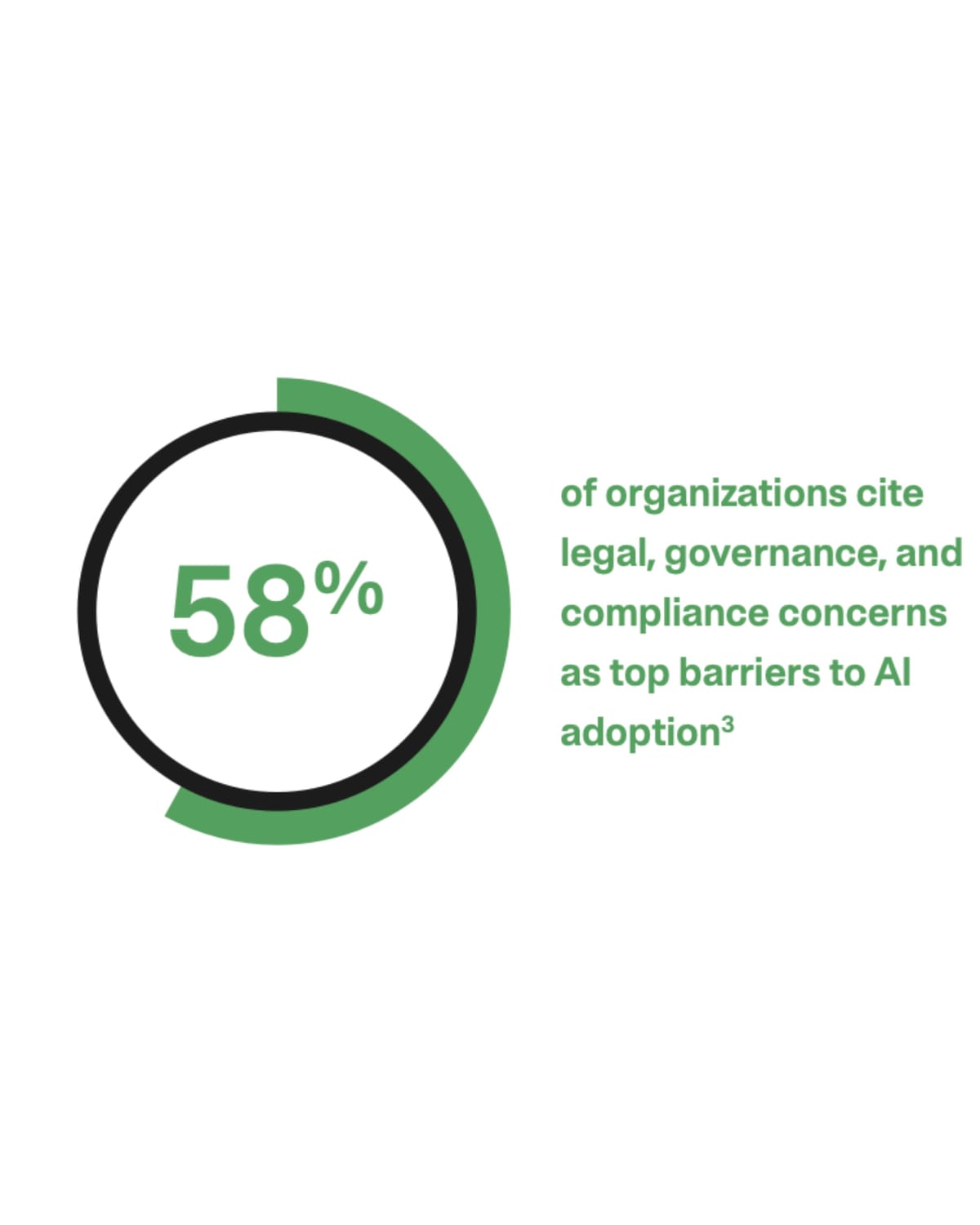
Many organizations still treat governance as paperwork rather than infrastructure. According to the IAB State of Data 2025 report, 58% of organizations cite legal, governance, and compliance concerns as top barriers to AI adoption. The same divide emerges across industries, with AI-ready companies integrating privacy, security, and risk signals into decision-making while others rely on patchwork controls and unclear ownership.
"Governance is shifting from managing risk to enabling innovation," according to Kabir Barday, CEO of OneTrust. "The organizations that get this right will move faster, deliver more value, and still stay compliant. This is a defining moment, governance teams have to evolve their programs to enable business outcomes, not just avoid risk."
AI-ready governance is becoming the operating model for modern business. It integrates privacy, risk, and compliance into one ecosystem that continuously monitors performance, enforces rules programmatically, and keeps humans in the loop where it matters most. Organizations building this capability now will earn long-term trust and market confidence. Governance maturity will become the next measure of resilience, much like cybersecurity became a decade earlier.
The report projects several developments for 2026. AI governance platforms will standardize programmatic control across data and systems. AI governance maturity will become a valuation driver in mergers, acquisitions, and investor due diligence processes. Privacy and risk teams will act as co-architects of business innovation rather than post-decision reviewers. Investors and insurers will tie coverage and valuation to AI accountability metrics.
Blake Brannon, chief innovation officer at OneTrust, emphasized that "artificial intelligence is reshaping how organizations operate, govern, and grow. The technology is moving into every product, every workflow, and every decision. Its potential is extraordinary, but it brings new, critical responsibilities that reach every corner of business. The governance of AI will determine how fast innovation can move and how much trust an organization can earn along the way."
Global regulatory landscape creates compliance complexity
The report includes comprehensive analysis of emerging global AI regulations. Over 3,200 regulatory updates occurred during 2025, with 875 related to AI laws and regulations. Total GDPR enforcement reached €2 billion in 2025. Globally, 97 AI laws remain in progress, 15 have passed, and 51 are in force. More than 40 United States states introduced or considered nearly 700 AI-related bills.
The EU AI Act published in the Official Journal of the European Union on July 12, 2024, entered effect on August 1, 2024. Provisions phase in through 2027, with general rules and prohibited practices taking effect in early 2025, general-purpose AI and penalties following in 2025, and classification rules for high-risk systems in 2027. The Act establishes obligations around documentation, transparency, and risk management. With more laws emerging worldwide, many organizations take a "design once, apply globally" approach using the EU AI Act as foundation for AI governance across markets.
The European Commission also announced the Digital Omnibus, a proposed reform package aimed at simplifying and aligning existing digital and privacy frameworks with the emerging AI ecosystem. The proposal could narrow the definition of personal data potentially excluding pseudonymous identifiers such as ad IDs and cookies. It would limit data-subject rights to information processed specifically for data-protection purposes and ease restrictions on sensitive data. The definition of legitimate interest would expand to allow AI training on personal data without prior consent.
Colorado became the first state to implement comprehensive AI law through the Colorado AI Act signed on May 17, 2024. The effective date moved from February 2026 to June 30, 2026. California advanced multiple AI-focused measures including Senate Bill 942 for the AI Transparency Act signed August 29, 2024, taking effect January 2026, requiring disclosure of AI-driven decisions.
South Korea emerged as a leading regulatory market in Asia. The AI Basic Act signed into law on January 21, 2025, enters force on January 22, 2026. The Act covers broad ranges of AI systems including high-impact AI, Gen AI, and large-scale AI exceeding computational power thresholds. The Ministry of Science and ICT published a draft enforcement decree in September 2025 further defining obligations for transparency, safety, and risk assessment.
Brazil positioned itself as the next major jurisdiction to formalize comprehensive AI regulation. On December 19, 2024, Bill 2338 was approved in the Senate and awaits final approval by the Chamber of Deputies. The bill, closely aligned with the EU AI Act, introduces a risk-based classification system, prohibitions for certain practices, and extensive transparency and governance requirements.
Industry perspectives emphasize collaborative approaches
The report features insights from multiple industry leaders emphasizing collaboration between innovators and regulators. Adrián González Sanchez, global AI architect for digital natives and startups at Microsoft, noted that "we are watching ethics, responsible AI, and regulation begin to converge. That convergence is becoming a powerful lever for AI governance, especially as organizations adopt practical tools like AI Bills of Materials to connect legal expectations with technical decision-making."
Eduardo Ustaran, partner at Hogan Lovells International LLP, observed that "the defining shift of 2026 is the opportunity for innovators and regulators to align their positions and achieve a common goal. Around the world, digital regulators are more conscious than ever of their role to support innovation in a responsible and beneficial way."
Marijse van der Berg, senior solutions architect at Databricks, emphasized that "AI is forcing privacy, security, and data teams to operate as one. The risks are now so intertwined that governance can't be layered on at the end. Collaboration has to begin at design, with shared ownership for how data and AI foundations are built, evaluated, and monitored."
Leonie Power, partner at FieldFisher, highlighted that "2026 will be a pivotal year for AI and data governance, marked by a potential recalibration by the EU of its regulatory stance. Organizations face a twofold mandate - accelerate responsibly and demonstrate an ethical approach towards protecting fundamental rights."
Elizabeth A. Sexton, director of product management at Adobe, argued that "governance must evolve from a static, end-of-process gate to an embedded, living layer of the entire workflow. When governance becomes part of the infrastructure - continuous, responsive, and context-aware - it stops being a barrier and becomes an accelerant."
Alex Verrechia, data protection officer and AI officer, stated that "transparency is becoming the defining measure of responsible AI. The conversations shaping 2026 are shifting from whether transparency is necessary to how effectively it can be achieved. True transparency creates accountability and enables trust between developers, regulators, and citizens."
Timeline
- August 1, 2024 - EU AI Act enters force
- January 21, 2025 - South Korea AI Basic Act signed into law
- February 2025 - EU Commission publishes guidance on prohibited AI practices
- May 17, 2024 - Colorado AI Act signed, effective date June 30, 2026
- July 10, 2025 - EU publishes final General-Purpose AI Code of Practice
- July 18, 2025 - European Commission releases comprehensive AI model guidelines
- August 2, 2025 - AI Act obligations for general-purpose AI models enter application
- January 22, 2026 - South Korea AI Basic Act enters force
- June 30, 2026 - Colorado AI Act becomes effective
- August 2, 2026 - EU AI Act full enforcement powers activate
- August 2026 - Netherlands regulatory sandbox launches
- August 2, 2027 - Compliance deadline for AI models placed on market before August 2, 2025
Summary
Who: OneTrust, a privacy technology company serving more than 14,000 customers globally, released predictions affecting AI developers, technology companies, governance professionals, privacy teams, risk management specialists, and organizations deploying artificial intelligence systems across marketing, human resources, finance, and customer service functions.
What: The 2026 Predictions Report identifies five critical shifts in AI governance including legal framework evolution adapting existing regulations rather than creating new categories, third-party AI risk acceleration requiring enhanced vendor assessment, agentic AI reshaping governance from observation to orchestration, accountability shifting from developers to deployers, and governance infrastructure becoming the determining factor separating scalable AI deployments from failed pilots.
When: OneTrust published the report on January 24, 2026, as regulatory frameworks entered enforcement phases with EU AI Act general-purpose model obligations effective August 2, 2025, full enforcement powers activating August 2026, and compliance deadlines extending through August 2027 for existing models.
Where: The predictions apply globally with particular focus on European Union markets where the AI Act establishes comprehensive frameworks, United States state-level legislation in Colorado, California, New York, and Texas, South Korean AI Basic Act implementation beginning January 2026, and Brazilian regulatory frameworks awaiting final legislative approval.
Why: Organizations struggle matching manual governance processes with machine-speed AI decision-making as 90% of advanced adopters report AI exposed limitations in siloed governance, 70% of technology leaders acknowledge governance capabilities cannot match AI initiative velocity, and 95% of enterprise GenAI pilots fail to scale due to accountability gaps rather than technical limitations, making governance infrastructure the critical factor determining which organizations will succeed in AI-driven economies.
Share this article
The link has been copied!