Google gives advertisers one placement list to rule them all
Account-level placement exclusions consolidate brand safety controls across Performance Max, Demand Gen, YouTube and Display in a single Google Ads setting.


Account-level placement exclusions consolidate brand safety controls across Performance Max, Demand Gen, YouTube and Display in a single Google Ads setting.
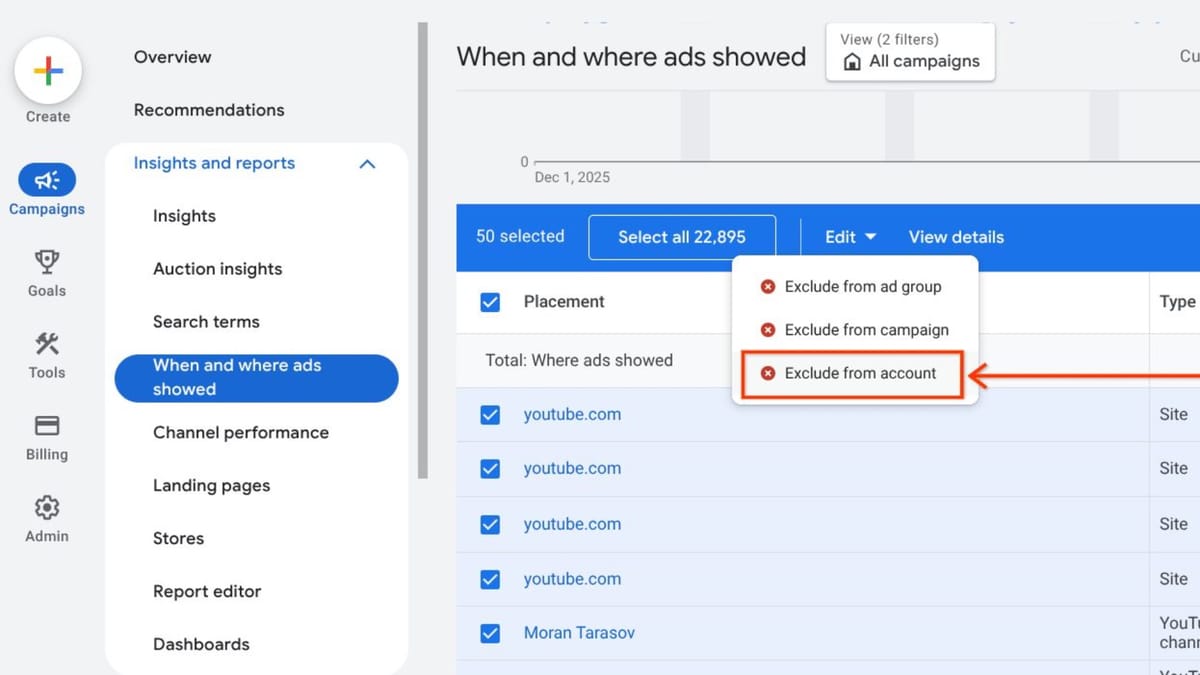
Google Ads today enabled account-level placement exclusions, allowing advertisers to block unwanted websites, apps, and YouTube channels from a centralized location that applies across all campaign types. The feature eliminates the previous requirement to manage exclusions separately for each campaign or ad group.
Aleksejus Podpruginas, a Google Ads campaigns specialist, documented the update in a LinkedIn post on January 14, 2026. Advertisers can now "implement Account-Level Placement Exclusions that apply across your entire Google Ads account."
The technical implementation creates a unified exclusion list that functions across Google Display Network, YouTube, Performance Max, and Demand Gen campaigns simultaneously. Previously, advertisers managed placement exclusions at the ad group or campaign level, requiring duplication of the same exclusion lists across multiple campaigns within an account.
The account-level functionality addresses specific challenges with Performance Max campaigns, which distribute advertisements across Google Search, Display, YouTube, Gmail, Maps, and Discover properties through automated optimization. Performance Max campaigns have historically offered limited transparency into specific placement decisions, making campaign-level exclusions the primary method for preventing ads from appearing on specific inventory.
According to Podpruginas's documentation, "This is the 'secret sauce' for PMax! Since PMax often feels like a 'black box,' account-level exclusions are the most effective way to force it away from irrelevant websites and apps." The automated nature of Performance Max campaign optimization means advertisers cannot manually select individual placements, making exclusion lists the primary placement control mechanism.
The feature operates through Google Ads' placement exclusion infrastructure, which allows advertisers to specify websites, apps, YouTube channels, or video content where advertisements should not appear. Once configured at the account level, the system automatically applies these exclusions to all eligible campaigns without requiring manual configuration in each campaign.
Account-level placement exclusions complement existing brand safety controls that Google has deployed throughout 2025. In November 2025, Google introduced brand suitability controls for Demand Gen campaigns through the Content Suitability Center, enabling advertisers to exclude specific content themes including tragedy coverage, political content, or religious themes from YouTube Home feed and watch next feed placements.
Google completed its Performance Max brand guidelines rollout in July 2025, shifting brand asset management from asset group level to campaign level. That structural change represented what Google described as "a substantial shift in how brand assets are managed within the Google Ads ecosystem."
The account-level exclusion system operates independently from campaign-level and ad group-level exclusions that advertisers may have previously configured. Existing exclusions at lower levels remain active, with the account-level list providing an additional layer of filtering. Advertisers can maintain both account-level and campaign-specific exclusions simultaneously, with the system respecting all exclusion configurations.
The implementation does not specify maximum limits on the number of placements that can be excluded at the account level. Campaign-level and ad group-level exclusion lists have historically supported hundreds of placements, though Google's documentation does not confirm whether the same limits apply to account-level lists.
Placement exclusions function through exact matching against website domains, app package names, YouTube channel IDs, or specific YouTube video IDs. The system does not support pattern matching or wildcard exclusions, requiring advertisers to specify each placement individually. For website exclusions, advertisers can block entire domains or specific subdirectories within a domain.
The feature's rollout timing suggests it may still be in beta testing. According to one comment on Podpruginas's LinkedIn post, "Great update, but still BETA not applicable for all the accounts yet." Google frequently deploys new features through gradual rollout processes, making them available to subsets of advertisers before expanding availability.
Buy ads on PPC Land. PPC Land has standard and native ad formats via major DSPs and ad platforms like Google Ads. Via an auction CPM, you can reach industry professionals.
The centralized management approach eliminates redundant work for advertisers managing multiple campaigns. Podpruginas characterized the time savings: "No more duplicating 'junk lists' across 10 different campaigns. Clean it once at the top, and the results trickle down everywhere."
Advertisers commonly maintain lists of low-quality websites, mobile applications, or YouTube channels where they prefer not to advertise. These "junk lists" typically include content farms, made-for-advertising sites, apps with accidental click patterns, or channels producing content inconsistent with brand standards. Before account-level exclusions, applying these lists required manual addition to each campaign or systematic use of Google Ads Editor to copy exclusions across campaigns.
The operational efficiency extends to account structures with multiple Performance Max campaigns. Large advertisers often operate separate Performance Max campaigns for different product categories, geographic markets, or business objectives. Each campaign previously required its own placement exclusion configuration, creating maintenance overhead when adjusting exclusion strategies.
Account-level exclusions also address challenges specific to newly created campaigns. When launching additional campaigns, advertisers can rely on account-level exclusions to provide baseline brand safety protection immediately, rather than needing to configure exclusions before activating each new campaign.
The feature serves dual purposes of brand safety enforcement and budget efficiency. Brand safety concerns focus on preventing advertisements from appearing adjacent to content that conflicts with advertiser values or brand positioning. Budget efficiency considerations target placements that generate impressions or clicks without producing meaningful business outcomes.
Podpruginas emphasized both dimensions in his announcement: "By filtering out low-quality placements at the account level, you're not just saving time, you're ensuring your budget is spent on high-intent surfaces that actually drive conversions."
Third-party verification providers have expanded measurement capabilities for Google's automated campaign types throughout 2024 and 2025. Integral Ad Science expanded brand safety measurement to Performance Max and Demand Gen campaigns in June 2024, providing advertisers with placement-level data on content adjacency issues.
The December 2025 IAS Industry Pulse Report found that 56% of UK media experts identified ad adjacency to AI-generated content as a major challenge for 2026, reflecting ongoing concerns about brand safety in automated advertising environments. Account-level placement exclusions provide a direct mechanism for addressing these concerns by blocking specific placements proactively rather than relying on post-campaign analysis and adjustment.
Google Ads maintains a hierarchical structure for campaign controls, with settings at account, campaign, and ad group levels. The placement exclusion system now operates across all three levels, with exclusions at any level preventing ad delivery to the specified placements.
The relationship between account-level, campaign-level, and ad group-level exclusions follows additive logic rather than override logic. If a placement is excluded at the account level, campaign-level settings cannot override that exclusion to allow ads on that placement. This ensures account-level exclusions function as absolute boundaries that apply across all campaigns regardless of lower-level configuration.
The additive approach contrasts with some other Google Ads settings where campaign-level or ad group-level configurations can override account-level defaults. For exclusions specifically, the system implements the most restrictive configuration at any level, ensuring maximum control for advertisers who establish account-level brand safety standards.
Account-level placement exclusions join other account-level controls that Google has introduced or enhanced throughout 2025. Google Ads Editor 2.11 added account-level placement and IP exclusions to the desktop application in November 2025, providing offline editing capabilities for centralized exclusion management.
IP address exclusions have operated at the account level since at least 2024, when Google introduced IP address exclusions for Performance Max campaigns in April 2024. The IP exclusion functionality allows advertisers to block specific IP addresses or network ranges from seeing advertisements, typically used to prevent internal traffic from company networks or competitors from viewing ads.
The availability of account-level placement exclusions may influence how advertisers structure campaigns and manage brand safety controls. Previously, advertisers needed to balance the operational overhead of maintaining consistent exclusions across campaigns against the risk of incomplete protection if exclusions were not properly replicated.
With account-level exclusions available, advertisers can establish baseline brand safety standards that apply universally while maintaining campaign-specific or ad group-specific exclusions for situations requiring additional filtering. This creates a two-tier approach: account-level exclusions handle universal brand safety requirements, while campaign-level exclusions address specific strategic considerations for individual campaigns.
The feature particularly benefits large-scale advertisers operating dozens or hundreds of campaigns across Google Ads. Enterprise advertisers, agencies managing multiple client accounts, and organizations with complex product portfolios can now enforce consistent brand safety policies without requiring extensive campaign-by-campaign configuration.
The development arrives as Google continues expanding automated campaign capabilities while responding to advertiser demands for greater control and transparency. In September 2025, Google introduced text guidelines for AI-powered campaigns, allowing advertisers to exclude up to 25 specific words or phrases from AI-generated text assets and specify up to 40 natural language messaging restrictions.
The feature's apparent beta status suggests advertisers should verify availability in their specific accounts before relying on account-level exclusions for brand safety protection. Google typically deploys new features through gradual rollout processes, with initial availability limited to subsets of advertisers before expanding to all accounts.
Advertisers who cannot access account-level placement exclusions should continue using campaign-level or ad group-level exclusions to maintain brand safety controls. Once account-level functionality becomes available, advertisers can consolidate existing exclusions to the account level and remove redundant campaign-level configurations.
The transition to account-level management may require coordination for agencies or teams managing shared accounts. Multiple users with access to a Google Ads account can modify account-level settings, making documentation and communication important to ensure exclusion lists reflect current brand safety requirements.
Organizations should establish governance processes for account-level exclusion management, including documentation of which placements are excluded and the rationale for each exclusion. Regular review of account-level exclusions ensures the list remains current as website landscapes change and new placement concerns emerge.
The feature represents Google's continued evolution of placement controls across its automated advertising systems. As automated campaigns like Performance Max and Demand Gen handle increasing advertising spend, advertisers have consistently requested stronger mechanisms for controlling where advertisements appear while maintaining the efficiency benefits of automated optimization.
Subscribe PPC Land newsletter ✉️ for similar stories like this one
Subscribe PPC Land newsletter ✉️ for similar stories like this one
Who: Google Ads and its advertisers managing campaigns across Performance Max, Demand Gen, YouTube, and Display formats. Aleksejus Podpruginas, a Google Ads campaigns specialist, first documented the feature publicly.
What: Account-level placement exclusions allow advertisers to block unwanted websites, apps, and YouTube channels from a single centralized setting that applies across all campaign types within a Google Ads account, replacing the previous requirement to manage exclusions separately at campaign or ad group level.
When: The feature was documented on January 14, 2026, though it appears to be in beta testing with limited availability across Google Ads accounts.
Where: The functionality operates across Google's advertising network including Display Network, YouTube, Performance Max, and Demand Gen campaigns, applying to all placements where Google serves advertisements.
Why: The feature addresses operational efficiency challenges and brand safety concerns by eliminating the need to duplicate exclusion lists across multiple campaigns, particularly important for automated campaign types like Performance Max where advertisers have limited visibility into specific placement decisions made by Google's machine learning systems.