
Amazon's Health AI assistant quietly solves what doctors' offices never could
Amazon One Medical launched a Health AI assistant this week providing 24/7 personalized health guidance, appointment booking, and autonomous prescription management.

Amazon One Medical launched a Health AI assistant this week providing 24/7 personalized health guidance, appointment booking, and autonomous prescription management.
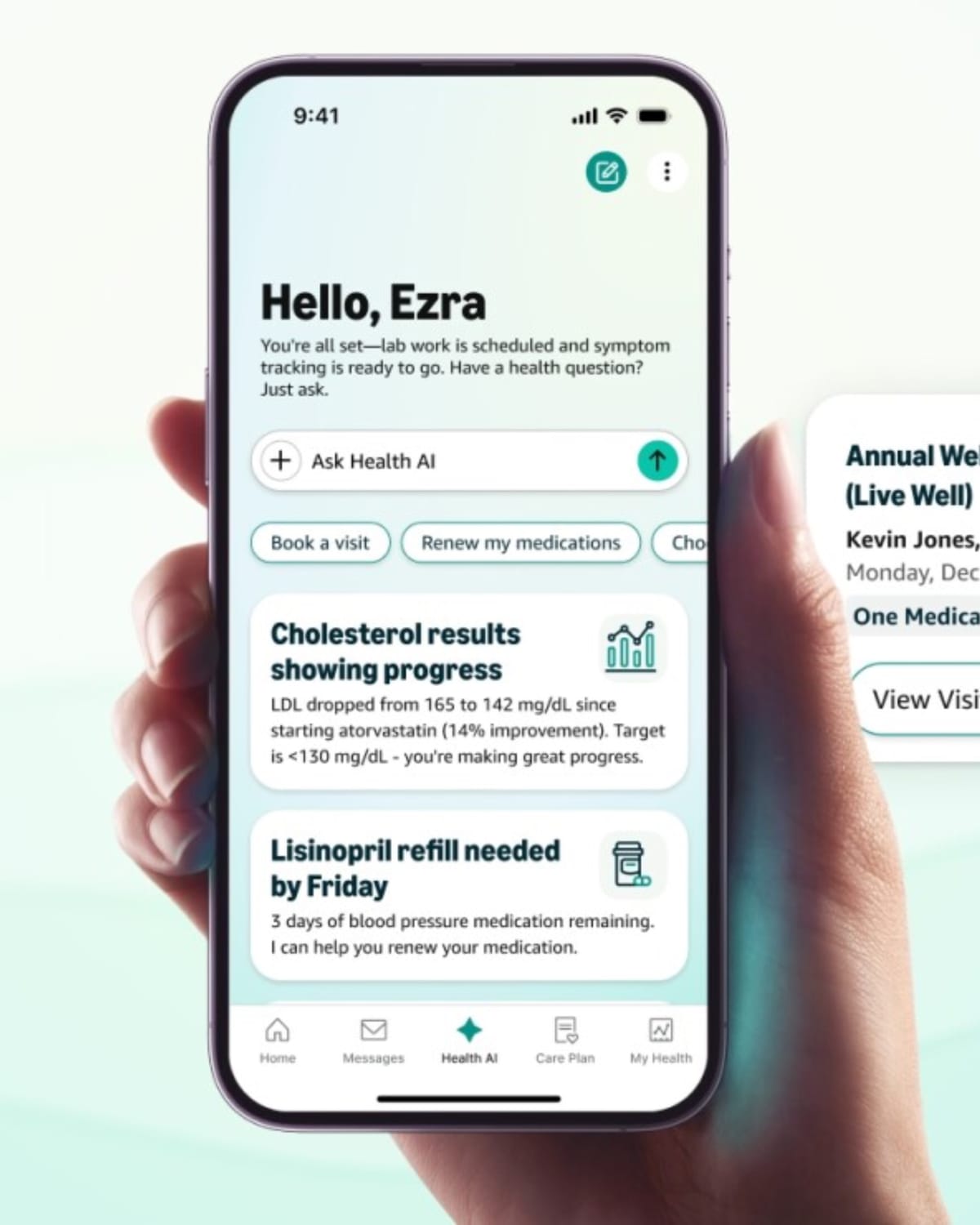
Amazon One Medical this week launched its Health AI assistant in the One Medical app, introducing an agentic artificial intelligence system that provides 24/7 personalized health guidance while autonomously booking appointments and managing medications across the company's membership base of millions. The announcement positions Amazon directly against traditional healthcare delivery models by embedding autonomous capabilities into routine medical interactions.
According to the announcement from Amazon, the Health AI assistant represents what Amazon describes as making healthcare "simpler, more highly personalized, and more actionable" through answers to health questions, appointment scheduling, and medication management. The system operates within the One Medical app with access to each patient's complete medical records, laboratory results, and current medications while maintaining Health Insurance Portability and Accountability Act-compliant privacy safeguards.
Neil Lindsay, senior vice president of Amazon Health Services, characterized the United States healthcare experience as fundamentally fragmented. "The U.S. health care experience is fragmented, with each provider seeing only parts of your health puzzle," Lindsay stated. "Health AI in the One Medical app brings together all the pieces of your personal health information to give you a more complete picture."
The system became available to Amazon One Medical members today in the One Medical app. More than 250 million customers have used Amazon's various health services, with the company positioning the Health AI assistant as complementing the trusted relationship between patients and healthcare providers rather than replacing physician interactions.
The Health AI assistant delivers personalized insights drawn from complete medical records, laboratory results, and current medications. Unlike generic health information tools that require manual data uploads from multiple providers, Health AI accesses the patient's medical context automatically through integration with One Medical's existing healthcare infrastructure.
The system can answer general and complex health questions by explaining laboratory results while considering unique health history and clarifying what information means for individual patients. It provides 24/7 health guidance on symptoms, conditions, potential treatments, and wellness questions without requiring appointment scheduling for basic inquiries.
The assistant helps patients choose appropriate care options based on specific situations, including virtual visits, in-person appointments, or urgent care. It streamlines ongoing care tasks by helping book appointments with One Medical providers and renewing medications, which patients can choose to fill with Amazon Pharmacy.
According to Dr. Andrew Diamond, chief medical officer at One Medical, the Health AI assistant enhances the patient-clinician relationship built over time. "Even as AI capabilities expand, the patient-clinician relationship - built over time and rooted in shared humanity - remains crucially important and irreplaceable," Diamond stated. "Our Health AI enhances this relationship by helping members understand their health information and manage their routine health tasks."
The system recognizes when symptoms, situations, or specific queries require human clinical judgment. Health AI provides options for members to connect with their One Medical provider through messaging, immediate video calls, or in-person appointments. If a member reports concerning symptoms or meets specific clinical criteria warranting in-person evaluation, Health AI recommends appropriate care levels and makes appointments - often for the same or next day, or in minutes when needed.
Amazon Health Services maintains HIPAA-compliant privacy and security practices across its One Medical and Amazon Pharmacy operations. The Health AI assistant extends these standards through specific technical and procedural safeguards designed to protect patient information.
Conversations with the Health AI assistant are not automatically added to medical records. Health data receives protection through strict administrative, physical, and technical safeguards including encryption technology and controls over record access. Amazon does not sell members' personal data, including protected health information.
Prakash Bulusu, vice president of Health Stores & Technology at Amazon Health Services, emphasized the company's commitment to responsible artificial intelligence implementation. "We're committed to developing responsible, reliable AI that makes our members' lives better," Bulusu stated. "Health AI in the One Medical app excels at connecting the dots across a member's complete health picture while maintaining rigorous safety standards."
Members maintain control over Health AI usage. Those who prefer not to use the assistant can access the standard One Medical app experience by tapping "Home" on the bottom navigation bar within the application.
The Health AI assistant operates with Health Insurance Portability and Accountability Act compliance across all interactions. According to Amazon's documentation, protected health information remains under the same regulatory framework governing One Medical's primary care operations.
One Medical's clinical leadership participated deeply in every development stage, embedding multiple patient safety guardrails and clinical protocols throughout the Health AI experience. The implementation includes specific protocols for emergency situations and sensitive clinical contexts.
The system addresses what Amazon characterizes as recognizing when symptoms, situations, or queries require or benefit from human clinical judgment. Health AI provides options for members to seamlessly connect with One Medical providers through messaging, immediate video calls, or in-person appointments rather than attempting to resolve all medical questions through artificial intelligence alone.
Clinical protocols determine when Health AI recommends in-person evaluation. If members report concerning symptoms or have specific clinical criteria warranting physical examination, the system recommends appropriate care levels and facilitates appointment scheduling. Same-day and next-day appointments remain available through the Health AI interface, with urgent situations receiving immediate attention.
The assistant operates within existing One Medical interfaces rather than requiring separate platform access. Campaigns only launch after members review and approve automated recommendations, maintaining human oversight of healthcare decisions. This architectural approach ensures that while the system automates routine tasks and information provision, critical medical decisions retain physician involvement.
One Medical providers can access Health AI interactions when clinically relevant to patient care. The transparency mechanism allows physicians to understand what information the system provided to patients before clinical encounters, enabling more informed conversations about symptoms, concerns, and treatment options.
A Health AI assistant became available to select One Medical members in beta testing since early 2025. One Medical actively collected feedback from members and clinicians throughout the beta period, continuously improving accuracy, helpfulness, and capabilities of the experience.
The company documented specific performance metrics during beta testing, though detailed quantitative results were not included in the announcement. One Medical stated that new features are planned to further enhance the membership experience based on beta testing insights.
The Health AI assistant relies on models running on Amazon Bedrock, Amazon's cloud-based artificial intelligence infrastructure. The technical implementation reflects Amazon's substantial investments in artificial intelligence capabilities across its business operations.
According to the announcement, One Medical membership is not required for scheduled in-person or remote appointments. However, One Medical membership can be added as a Prime benefit for $9 per month or $99 per year for Amazon Prime members. The membership also can be purchased directly at One Medical.
The deployment timeline demonstrates Amazon's accelerated approach to healthcare artificial intelligence. The beta testing period beginning in early 2025 compressed what traditionally would represent years of healthcare technology development into months of concentrated iteration and refinement.
The Health AI assistant launch arrives as healthcare organizations race to deploy autonomous artificial intelligence systems across medical operations. Amazon's broader agentic AI strategy includes autonomous campaign management tools across its advertising platform, autonomous seller assistance for marketplace operations, and now healthcare guidance through One Medical.
The healthcare artificial intelligence market faces substantial growth projections. Agentic AI infrastructure dominated advertising industry deployments throughout 2025, with multiple platforms introducing autonomous capabilities for campaign management and customer service operations.
Amazon's approach differs from healthcare competitors by leveraging existing infrastructure across One Medical's primary care network and Amazon Pharmacy's prescription fulfillment operations. The integrated approach enables the Health AI assistant to access comprehensive patient data while facilitating actions including appointment booking and medication management without requiring external system coordination.
The announcement arrives as AI assistants expand capabilities across consumer applications, with Google deploying Personal Intelligence features that access Gmail, Google Photos, and YouTube data to deliver personalized responses. The parallel development patterns suggest healthcare represents one component of broader artificial intelligence assistant deployment across multiple industries.
Healthcare privacy regulations impose stricter requirements than general consumer applications. The Health Insurance Portability and Accountability Act establishes federal standards for protecting sensitive patient health information, creating compliance obligations that extend beyond general data protection regulations. California's recent enforcement actions against health publishers for sharing personal data with third parties despite user opt-outs demonstrate regulatory scrutiny of health information handling practices.
The Health AI assistant implementation signals fundamental shifts in how patients access medical information and coordinate care. Traditional healthcare delivery relies on scheduled appointments for routine questions, medication refills, and care coordination - creating delays and access barriers for patients managing chronic conditions or seeking basic medical guidance.
Autonomous health assistants address operational inefficiencies by handling routine tasks including appointment scheduling, prescription renewals, and basic health questions without physician involvement. This task redistribution allows healthcare providers to focus clinical expertise on complex medical decisions while artificial intelligence manages administrative workflows.
The 24/7 availability fundamentally alters patient expectations around healthcare access. Rather than waiting for office hours or scheduling appointments for routine questions, patients receive immediate guidance on symptoms, laboratory results, and medication management. This shift toward on-demand healthcare information mirrors broader consumer service evolution toward instant digital access.
Integration with Amazon Pharmacy creates a closed-loop system where Health AI can identify medication needs, facilitate prescription renewals through One Medical providers, and direct fulfillment through Amazon's pharmacy operations. The vertical integration enables Amazon to control the complete patient experience from initial symptom inquiry through medication delivery.
The deployment raises questions about physician autonomy and decision-making authority. While Amazon emphasizes that Health AI complements rather than replaces physician relationships, the system's ability to provide medical guidance, interpret laboratory results, and facilitate treatment decisions positions artificial intelligence as an intermediate layer between patients and physicians.
Healthcare organizations have historically struggled with technology adoption due to regulatory complexity, liability concerns, and fragmented information systems. Amazon's approach of embedding AI directly into existing One Medical infrastructure demonstrates one path toward overcoming implementation barriers through controlled environments where the company manages both the technology platform and underlying healthcare delivery.
The economic implications extend beyond operational efficiency. If autonomous assistants can effectively handle routine medical inquiries and care coordination, healthcare organizations might reduce staffing requirements for administrative and clinical support roles. The workforce transformation would parallel automation trends across other industries where agentic AI systems assume tasks previously requiring human intervention.
Patient data ownership and portability concerns accompany autonomous health assistants. As Amazon accumulates comprehensive health histories through One Medical operations and Health AI interactions, questions arise about patient rights to access, transfer, and delete personal health information. The company's privacy commitments address current regulatory requirements, but the scale of health data aggregation creates new concentration risks.
The Health AI assistant also reflects Amazon's broader healthcare strategy spanning One Medical primary care, Amazon Pharmacy prescription fulfillment, and related health services. The integrated approach positions Amazon to capture value across multiple healthcare touchpoints while leveraging data collected through one service to enhance others - creating network effects that could prove difficult for fragmented competitors to match.
Amazon One Medical operates as a hybrid healthcare model combining membership fees with insurance billing for medical services. The membership structure charges $99 per year for Prime members ($9 monthly) or $199 annually for non-Prime customers. The fee covers access to the One Medical app, 24/7 on-demand virtual care, and value-added services including insurance navigation and referral management.
The membership model separates from traditional fee-for-service healthcare where patients pay directly or through insurance for each medical interaction. Instead, the annual membership provides unlimited access to specific services while scheduled in-person and remote visits are billed to insurance with applicable copays and deductibles.
This pricing architecture positions One Medical differently from traditional primary care practices and competing telehealth services. Competitors including Teladoc and Doctor on Demand typically charge per-visit fees or operate through employer-sponsored health plans. One Medical's membership approach attempts to create recurring revenue while encouraging frequent platform engagement.
The Health AI assistant enhances membership value by providing continuous health guidance beyond scheduled appointments. Members gain 24/7 access to personalized medical information, laboratory result interpretation, and care coordination assistance - services that would traditionally require scheduling separate physician consultations or navigating healthcare bureaucracy independently.
Amazon's Pay-per-visit service provides an alternative for customers seeking one-time virtual visits without membership commitment. The service charges flat fees starting from $29 for message-only visits or $49 for video visits, addressing specific common health conditions through telehealth interactions. The dual-track approach enables Amazon to capture both recurring membership revenue and transaction fees from episodic healthcare needs.
Market segmentation emerges from this pricing structure. Customers with ongoing healthcare needs and those living near One Medical offices receive greater value from membership through comprehensive primary care access and continuous health guidance. Customers seeking occasional virtual care for acute conditions might prefer Pay-per-visit's transaction-based pricing without annual commitment.
The integration between Health AI and membership economics creates retention incentives. As the assistant accumulates patient health history and demonstrates value through personalized guidance, members develop dependency on the accumulated knowledge base - increasing switching costs to alternative healthcare providers who would lack equivalent historical context.
The Health AI assistant operates on Amazon Bedrock, the company's managed artificial intelligence service providing access to foundation models from multiple providers. The Bedrock infrastructure enables One Medical to leverage large language models while maintaining HIPAA compliance and data security requirements specific to healthcare applications.
The system architecture separates conversation storage from medical record integration. According to Amazon's documentation, conversations with Health AI are not automatically added to patient medical records - maintaining distinction between informal health inquiries and formal clinical documentation. This separation addresses liability concerns while allowing patients to explore health questions without creating permanent medical record entries.
The assistant accesses comprehensive patient data including complete medical records, laboratory results, vaccination history, and current medications. This integration distinguishes Health AI from generic health information chatbots that rely solely on user-provided information. The system can reference specific test results, identify drug interactions based on current prescriptions, and provide guidance informed by documented medical conditions.
Natural language processing capabilities enable the assistant to interpret medical questions in conversational language rather than requiring precise clinical terminology. Patients can ask questions using everyday vocabulary while the system translates inquiries into clinically relevant concepts and provides responses in accessible language.
The appointment booking functionality demonstrates integration between conversational interface and operational systems. When Health AI determines that in-person evaluation or scheduled consultation would benefit the patient, the system can access appointment availability, present scheduling options, and complete booking without requiring separate navigation to scheduling interfaces.
Medication management capabilities connect to prescription systems and Amazon Pharmacy infrastructure. The assistant can identify when prescription renewals are due, facilitate renewal requests through One Medical providers, and direct medication fulfillment to Amazon Pharmacy - creating streamlined workflow from identification of medication need through delivery.
The system employs what Amazon characterizes as "rigorous safety standards" through multiple technical and procedural controls. Clinical protocols embedded in the system logic determine when to escalate situations to human providers, when to recommend in-person evaluation, and how to handle emergency situations or sensitive health concerns.
The technical implementation reflects broader trends in agentic AI development where autonomous systems combine reasoning capabilities with practical action-taking abilities through tool access and orchestration layers. The Health AI assistant represents application of these architectural patterns to healthcare delivery with additional safety guardrails and regulatory compliance measures.
The Health AI assistant deployment signals acceleration in healthcare digital transformation beyond administrative automation toward clinical decision support and patient engagement. Traditional healthcare technology focused primarily on electronic health records, billing systems, and administrative workflow - treating digital systems as record-keeping tools rather than active participants in care delivery.
Autonomous health assistants represent qualitative shift where artificial intelligence participates in clinical conversations, interprets medical data, and guides care decisions. The transition from passive record systems to active clinical support creates new dynamics in physician-patient-technology relationships.
Healthcare organizations face mounting pressure to improve access while controlling costs. Primary care physician shortages, particularly in rural areas, create capacity constraints limiting appointment availability. Autonomous assistants partially address access barriers by handling routine inquiries and care coordination without requiring physician time.
The Centers for Medicare & Medicaid Services and private insurers increasingly emphasize value-based care models that reward health outcomes rather than service volume. These payment structures create incentives for preventive care, chronic disease management, and patient engagement - areas where continuous digital health guidance could influence outcomes.
Regulatory frameworks governing artificial intelligence in healthcare remain fragmented. The Food and Drug Administration regulates medical devices including certain clinical decision support software, but many health information tools fall outside device definitions. This regulatory ambiguity creates implementation flexibility while raising questions about appropriate oversight levels for AI systems providing medical guidance.
Professional liability considerations accompany AI deployment in clinical contexts. Questions persist about responsibility allocation when autonomous systems provide medical guidance that proves incorrect or incomplete. Healthcare organizations deploying such systems must navigate malpractice risk while leveraging AI capabilities to improve care delivery.
Patient acceptance represents another adoption factor. While younger demographics demonstrate comfort with digital health tools, older populations managing chronic conditions might prefer traditional physician interactions. The Health AI assistant's positioning as complementing rather than replacing physician relationships attempts to bridge this acceptance gap.
Healthcare data interoperability challenges complicate AI assistant deployment beyond controlled ecosystems like One Medical. Patients receiving care from multiple providers across different health systems accumulate fragmented medical records that AI assistants cannot easily access or synthesize. Amazon's integrated approach addresses this limitation within its own healthcare operations but doesn't solve broader industry interoperability problems.
The deployment also reflects changing consumer expectations around healthcare service delivery. Amazon Prime members accustomed to one-click purchasing, same-day delivery, and 24/7 customer service increasingly expect similar convenience in healthcare interactions. The Health AI assistant extends Amazon's service model into medical care with continuous availability and immediate response capabilities.
Who: Amazon One Medical launched the Health AI assistant affecting members using the One Medical app for primary care services. The development involved Amazon Health Services leadership including Neil Lindsay (senior vice president), Dr. Andrew Diamond (chief medical officer at One Medical), and Prakash Bulusu (vice president of Health Stores & Technology). The system impacts healthcare delivery for patients managing chronic conditions, seeking routine medical guidance, and coordinating care across One Medical's primary care network.
What: The Health AI assistant provides autonomous health guidance through the One Medical app with capabilities including answering health questions by explaining laboratory results, providing 24/7 symptom guidance, helping choose appropriate care options between virtual visits, in-person appointments or urgent care, booking appointments with One Medical providers, and renewing medications with optional Amazon Pharmacy fulfillment. The system operates with HIPAA-compliant privacy safeguards while accessing complete medical records, laboratory results, and current medications. Clinical protocols ensure the assistant connects patients to providers when medical expertise is needed through messaging, video calls, or in-person appointments.
When: Amazon One Medical launched the Health AI assistant on January 21, 2026, following beta testing with select members since early 2025. The deployment arrives as healthcare organizations accelerate artificial intelligence implementations and Amazon expands autonomous capabilities across its business operations including advertising, marketplace selling, and now healthcare services.
Where: The Health AI assistant operates within the One Medical app available to members across the United States where One Medical provides services. The system connects to One Medical's primary care offices across U.S. cities while providing nationwide 24/7 virtual care access. Amazon Pharmacy integration enables prescription fulfillment to members' locations throughout the country.
Why: The Health AI assistant addresses fragmentation in U.S. healthcare where patients receive care from multiple providers who lack access to complete health information. The system makes healthcare interactions simpler, more personalized, and more actionable by consolidating medical records, laboratory results, and medications into unified interface providing continuous health guidance. The deployment reflects Amazon's strategy to leverage artificial intelligence and integrated healthcare infrastructure spanning One Medical primary care and Amazon Pharmacy to create differentiated patient experiences while improving access to routine medical information and care coordination without requiring scheduled physician appointments for every health question.