Amazon sellers face March deadline over inflated supplement claims
Amazon enforces dietary supplement policy targeting misleading ingredient claims with March 31, 2026 deactivation deadline for non-compliant listings.


Amazon enforces dietary supplement policy targeting misleading ingredient claims with March 31, 2026 deactivation deadline for non-compliant listings.
Dietary supplement sellers on Amazon face potential listing deactivations starting March 31, 2026, if their product detail pages contain misleading or unsubstantiated ingredient composition claims that fail to align with Supplement Facts Panels. The enforcement targets a specific practice that has proliferated across the marketplace: inflating raw material weights beyond actual extract amounts present in products.
The Amazon Regulatory Intelligence, Safety and Compliance team notified sellers through email communications warning that listings must "accurately represent extract and ingredient weights consistent with their Supplement Facts Panel (SFP) across the product detail page." The requirement enforces compliance with FDA labeling guidelines and Amazon's existing dietary supplements policy, which already prohibited misleading product information but lacked specific enforcement mechanisms for ingredient weight discrepancies.
Vanessa Hung, CEO of Online Seller Solutions, shared analysis of the announcement on LinkedIn stating Amazon is "drawing a hard line on supplement claims." She emphasized that the enforcement represents Amazon treating supplements as regulated labels rather than marketing content, writing "Amazon is no longer evaluating supplements as marketing content. It's evaluating them as regulated labels."
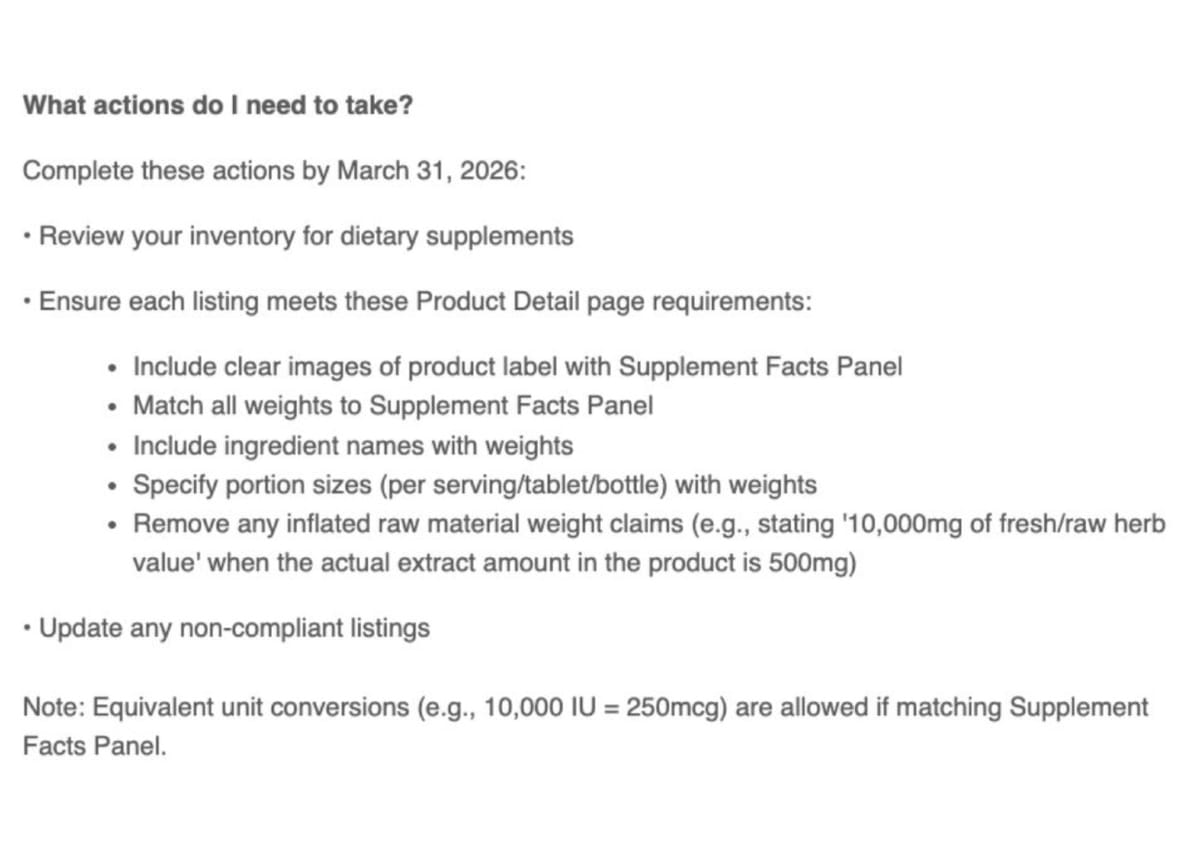
The enforcement targets several specific violations. Sellers cannot present inflated raw material weight claims when actual extract amounts differ substantially—for instance, stating 10,000mg of fresh or raw herb value when the actual extract amount in the product measures only 500mg. Product detail pages cannot present ingredient weights without specifying the associated ingredient name. Portion sizes such as per serving, per tablet, or per bottle must accompany all weight specifications.
Equivalent unit conversions remain permissible provided they match the Supplement Facts Panel. A supplement containing Vitamin C can present the quantity as both 10,000 IU and 250mcg if the Supplement Facts Panel reflects this conversion accurately. The distinction matters because sellers have historically converted actual extract amounts into raw material equivalents as marketing storytelling without explicit panel support.
Amazon's documentation specifies that all weights presented on product detail pages must match the Supplement Facts Panel exactly. Product images must include clear photographs of the complete product label affixed to the product, including the Supplement Facts Panel, ingredients list, and identifying codes such as matrix codes, lot numbers, or serial numbers. The images must show the name and address of the brand owner, manufacturer, packer, or distributor.
The enforcement arrives amid Amazon's broader platform governance modifications affecting third-party merchants. The marketplace introduced Seller Challenge functionality for Account Health Assurance participants in October 2025, enabling enhanced reviews of enforcement decisions after standard appeal attempts fail. That feature applies only to listing-level enforcements and provides sellers with three challenges per six-month period.
Hung characterized the dietary supplement enforcement as reflecting Amazon's shift toward label-led category management rather than marketing-led categorization. "Sellers who treat their listings like a regulated surface (not a sales page) will be fine, but those who rely on storytelling to bridge the gap between science and conversion will feel this quickly," she wrote in her analysis.
The March 31 deadline requires sellers to complete several actions. They must review inventory for dietary supplements and ensure each listing meets product detail page requirements including clear images of product labels with Supplement Facts Panels. All weights must match the Supplement Facts Panel exactly. Ingredient names with weights must appear consistently across all listing content. Portion sizes require specification with weights for every presentation format.
The enforcement represents one component of Amazon's comprehensive dietary supplements policy framework. According to Amazon's policy documentation, all dietary supplements must be manufactured in facilities compliant with FDA Current Good Manufacturing Practice regulations under 21 CFR 111 or 21 CFR 117. Third-party cGMP audits or certifications must be performed by accredited entities, with private audits, first-party audits, consulting audits, and FDA inspections excluded from acceptance.
Supplements intended for bodybuilding, joint health, sexual enhancement, sports nutrition, and weight management face additional testing requirements. These products must undergo testing for heavy metal and microbial contaminants, with some products also tested for pesticides according to NSF/ANSI 173-2024 or United States Pharmacopeia standards. Products must contain dietary ingredients according to tolerances listed in 21 CFR 101.36 and 101.9(g)(3) & (g)(4).
Buy ads on PPC Land. PPC Land has standard and native ad formats via major DSPs and ad platforms like Google Ads. Via an auction CPM, you can reach industry professionals.
The testing requirements extend to known adulterants outlined in NSF/ANSI 173-2024 section 5.3.5.1-4. Amazon partners with third-party testing, inspection, and certification service providers to validate product compliance rather than accepting documentation directly from sellers. This approach replaced previous direct submission procedures, according to Amazon's current policy framework.
Amazon prohibits several categories of dietary supplements entirely. Products cannot contain pure powdered caffeine, which the FDA has determined presents unreasonable risk of injury or illness. Supplements named in FDA recalls, safety alerts, or warning letters face immediate prohibition. Products identified by the Federal Trade Commission for making untrue marketing claims cannot advertise on the platform.
The policy explicitly forbids any supplements containing controlled substances including cannabidiol (CBD), Schedule I through V substances under the Controlled Substances Act, or "List I" chemicals designated by the Drug Enforcement Administration. Sexual enhancement and weight loss dietary supplement products cannot be sold in single- or double-pill packs regardless of ingredient composition.
Disease claims remain prohibited unless the statement has received FDA approval. Product listings cannot state that supplements diagnose, cure, mitigate, treat, or prevent disease in humans. Supplements cannot claim effects equivalent to controlled substances or prescription drugs, serve as alternatives to prescription drugs, or match prescription drug effectiveness. Product names that could be confused with controlled substances or prescription drugs face restriction, such as "Viagrex" or "TestosterX."
The enforcement timing coincides with Amazon's implementation of AI-powered cross-platform compliance monitoring. That system, deployed approximately one year ago according to May 2025 reports, automatically flags content on sellers' external websites that violates Amazon policies even when claims don't appear on Amazon listings themselves.
Amazon sellers have experienced multiple policy changes throughout 2025, with many reporting sales declines between 60-80% year-over-year. The marketplace introduced product title limitations restricting lengths to 200 characters effective January 21, 2025. The platform modified variation theme requirements in August 2025, ultimately limiting removals to deprecated themes with zero sales in the previous 12 months after seller backlash prompted policy revision.
The dietary supplement enforcement distinguishes between compliant mathematical conversions and prohibited marketing storytelling. When a Supplement Facts Panel lists an ingredient at 500mg extract, sellers cannot present this quantity as 10,000mg raw material value without explicit panel support for the conversion ratio. The practice transforms actual extract quantities into inflated raw material weights that consumers may misinterpret as indicating higher potency or concentration than products actually contain.
Sellers must update non-compliant listings before the March 31 deadline to avoid deactivation risk. Amazon provides detailed instructions through its "Fix attributes on a product detail page" documentation for sellers needing to modify listing content. The platform offers Selling Partner Support contact for sellers with questions about specific compliance scenarios.
The Regulatory Intelligence, Safety and Compliance team signed the notification sent to affected sellers. The team operates within Amazon's broader compliance infrastructure managing policy enforcement across the marketplace's health and wellness categories. Previous enforcement actions have targeted misleading variation reviews, with Amazon announcing January 7, 2026 modifications to prevent review sharing between functionally different product variations.
Hung's analysis emphasized the operational reality facing supplement sellers. Most deactivations won't result from defective products but from legacy copy never structurally audited against product labels. Listings with bullets referencing raw material equivalents, titles implying higher potency than Supplement Facts Panels document, or descriptions mixing extract weight and source weight face exposure regardless of underlying product compliance.
The enforcement affects multiple stakeholder categories within the Amazon ecosystem. Brand manufacturers maintaining direct relationships with Amazon through Vendor Central face identical requirements as third-party sellers operating through Seller Central. Private label sellers who formulate their own supplements must ensure marketing content aligns precisely with laboratory-verified Supplement Facts Panel data. Resellers distributing established brands must verify that product detail pages match manufacturer-provided labeling.
Amazon's dietary supplements policy prohibits products containing ingredients derived from animals protected under federal conservation legislation. The Endangered Species Act, Migratory Bird Act of 1918, Wild Bird Conservation Act, Bald and Golden Eagle Protection Act, Marine Mammal Protection Act, Lacey Act, and Convention on International Trade in Endangered Species establish these protections. Supplements cannot contain ingredients from sharks, whales, dolphins, or porpoises.
Products containing more than 12% hydrogen peroxide face prohibition regardless of intended use category. Patches marketed as dietary supplements or detox products cannot be sold on the platform. These categorical restrictions operate independently of the March 31 ingredient composition enforcement but form part of Amazon's comprehensive supplement governance framework.
The policy violations carry consequences beyond immediate listing deactivation. Amazon reserves authority under the Services Business Solutions Agreement to take additional actions including account suspension for repeated or egregious violations. The platform's enhanced enforcement through AI monitoring systems and third-party testing requirements creates multiple verification layers that sellers must navigate successfully to maintain marketplace access.
Sellers facing ingredient composition violations must address root causes within their listing creation and management processes. The enforcement targets systemic practices where marketing departments generate product content without rigorous verification against regulatory labeling. Companies relying on marketing agencies or third-party listing optimization services must ensure service providers understand FDA labeling requirements and Amazon's enforcement standards.
The March 31 deadline provides sellers with 76 days from the original notification date to achieve compliance. This timeline compresses multiple operational tasks: inventory audit across all dietary supplement ASINs, Supplement Facts Panel verification for each product, listing content review identifying non-compliant weight claims, image updates showing complete labels, and submission of corrected content through Amazon's listing management interfaces.
For sellers operating with limited compliance resources, the timeline presents significant operational challenges. Many supplement sellers maintain hundreds or thousands of active listings across multiple product categories. Each listing requires individual verification that bullet points, product descriptions, titles, backend search terms, and enhanced brand content align precisely with Supplement Facts Panel data.
The enforcement demonstrates Amazon's increasing sophistication in automated compliance monitoring. Platform algorithms can now parse listing content to identify ingredient weight claims, compare these claims against Supplement Facts Panel data extracted through image recognition, and flag discrepancies for enforcement action. This capability extends beyond manual review processes that historically limited Amazon's enforcement capacity across millions of active listings.
Hung noted that enforcement arrives as Amazon's automation deepens across the marketplace. The platform deployed agentic AI capabilities across seller platforms in September 2025, transforming Seller Assistant from passive question-answering to autonomous business partnership managing inventory, compliance, and advertising. These automation increases heighten the importance of human review mechanisms when algorithmic decisions require reconsideration.
The dietary supplement enforcement intersects with broader regulatory trends affecting health and wellness product marketing across digital platforms. The FDA maintains ongoing enforcement actions against companies making prohibited disease claims, with warning letters frequently citing online marketplace listings as violation evidence. Amazon's enforcement preemptively addresses regulatory risks by requiring seller compliance before external enforcement agencies intervene.
Federal law establishes the framework governing dietary supplement marketing. The Federal Food, Drug, and Cosmetic Act and Dietary Supplement Health and Education Act define permissible claims and labeling requirements. The FDA defines dietary ingredients as vitamins, minerals, herbs or other botanicals, amino acids, or dietary substances used to supplement the diet by increasing total dietary intake. Products come in forms including powders, pills, capsules, liquid drops, and oral sprays.
The enforcement specifically targets the presentation of ingredient composition rather than the underlying product formulation. A supplement containing 500mg of an herbal extract remains permissible provided all product detail page content accurately reflects this quantity. The violation occurs when listing content presents this quantity as 10,000mg through raw material equivalency conversions unsupported by the Supplement Facts Panel.
This distinction matters because raw material weights and extract weights measure fundamentally different product attributes. Raw material weight references the quantity of plant material used as extraction source. Extract weight measures the quantity of concentrated compound present in the finished product. A 10:1 extraction ratio means 10,000mg of raw material produces 1,000mg of extract. Presenting the raw material weight as if it represents extract quantity misleads consumers about actual product composition.
The enforcement acknowledges legitimate uses of weight conversions. International Unit (IU) conversions to metric measurements remain permissible because these conversions reflect standardized scientific relationships rather than marketing inflation. Vitamin D presented as 5,000 IU equals 125mcg through established conversion factors universally recognized in nutritional science. Sellers can present both measurements provided the Supplement Facts Panel documents both values.
Amazon's documentation directing sellers to the dietary supplements help page and "Fix attributes on a product detail page" resources demonstrates the platform's emphasis on seller education alongside enforcement. The company aims to achieve voluntary compliance through clear guidance rather than relying exclusively on punitive deactivation. This approach aligns with Amazon's broader pattern of policy implementation involving initial warnings, educational resources, and grace periods before strict enforcement begins.
The March 31 deadline date selection provides sellers with a compliance window extending through the first quarter of 2026. This timing avoids disruption during the critical fourth-quarter holiday selling season that concluded in December 2025. The deadline arrives before the second quarter when many supplement sellers begin preparing inventory and marketing campaigns for summer selling periods focused on fitness and weight management products.
Sellers who maintain strong documentation practices may find compliance relatively straightforward. Companies that already verify listing content against Supplement Facts Panels, maintain organized records of product labeling, and employ quality control processes reviewing marketing claims can likely achieve compliance through systematic audits. These sellers face primarily administrative burden rather than fundamental business model challenges.
Sellers who have built businesses around marketing storytelling that exaggerates product composition face more substantial adjustments. Listings generating sales through claims of "10,000mg potency" when products contain 500mg extract will require complete content overhauls. Title restructuring, bullet point rewrites, description modifications, and image replacements all become necessary to achieve compliance while maintaining sufficient marketing appeal to sustain conversion rates.
The Amazon enforcement occurs independently of FDA regulatory actions but reinforces federal labeling requirements through marketplace policy. The FDA generally does not pre-approve dietary supplements, instead regulating them through post-market surveillance and enforcement against violative products. Amazon's requirement for pre-market compliance verification through third-party testing creates a more restrictive standard than federal law mandates for market entry.
This elevated standard reflects Amazon's position as marketplace operator bearing reputational and potential liability risks from products sold through its platform. The company maintains authority under the Services Business Solutions Agreement to establish product quality standards exceeding regulatory minimums. Sellers accepting marketplace access agree to these enhanced requirements as conditions of participation.
Subscribe PPC Land newsletter ✉️ for similar stories like this one
Subscribe PPC Land newsletter ✉️ for similar stories like this one
Who: Amazon Regulatory Intelligence, Safety and Compliance team enforces policy against dietary supplement sellers presenting misleading ingredient composition claims. Vanessa Hung, CEO of Online Seller Solutions, provided public analysis of the enforcement's marketplace implications. The policy affects brand manufacturers, private label sellers, and resellers distributing supplements through Amazon's marketplace.
What: Amazon requires dietary supplement listings to accurately represent extract and ingredient weights consistent with Supplement Facts Panels across product detail pages. The enforcement targets inflated raw material weight claims presenting quantities like 10,000mg when actual extract amounts measure 500mg. Sellers must ensure ingredient names appear with weights, specify portion sizes, and match all weights to Supplement Facts Panels. Non-compliant listings face deactivation starting March 31, 2026.
When: Amazon sent notifications to affected sellers on January 14, 2026, establishing March 31, 2026 as the compliance deadline. The enforcement provides sellers with 76 days to review inventory, verify Supplement Facts Panels, update listing content, and submit corrections through Amazon's management interfaces.
Where: The policy enforcement applies across Amazon's United States marketplace affecting all dietary supplement categories including vitamins, minerals, herbs, botanicals, amino acids, and dietary substances. Enforcement occurs through Amazon Seller Central interfaces where sellers manage product listings, inventory, and compliance obligations.
Why: The requirement enforces compliance with FDA labeling guidelines and Amazon's dietary supplements policy prohibiting misleading product information. Amazon characterized the enforcement as ensuring accurate representation of extract and ingredient weights, treating supplements as regulated labels rather than marketing content. The policy addresses practices where marketing departments generate content without rigorous verification against regulatory labeling, creating consumer confusion about actual product composition and potency.