
AI agents will change how brands sell to customers in 2026
Kantar identifies AI agents, retail media hitting 1.8x better results, creator ROI demands among ten marketing trends reshaping brand strategy in 2026.

Kantar identifies AI agents, retail media hitting 1.8x better results, creator ROI demands among ten marketing trends reshaping brand strategy in 2026.
Marketing research firm Kantar released this month its annual trends forecast identifying ten critical shifts that will reshape brand strategy and advertising investments during 2026, with artificial intelligence agents mediating purchase decisions emerging as the most significant transformation facing marketers.
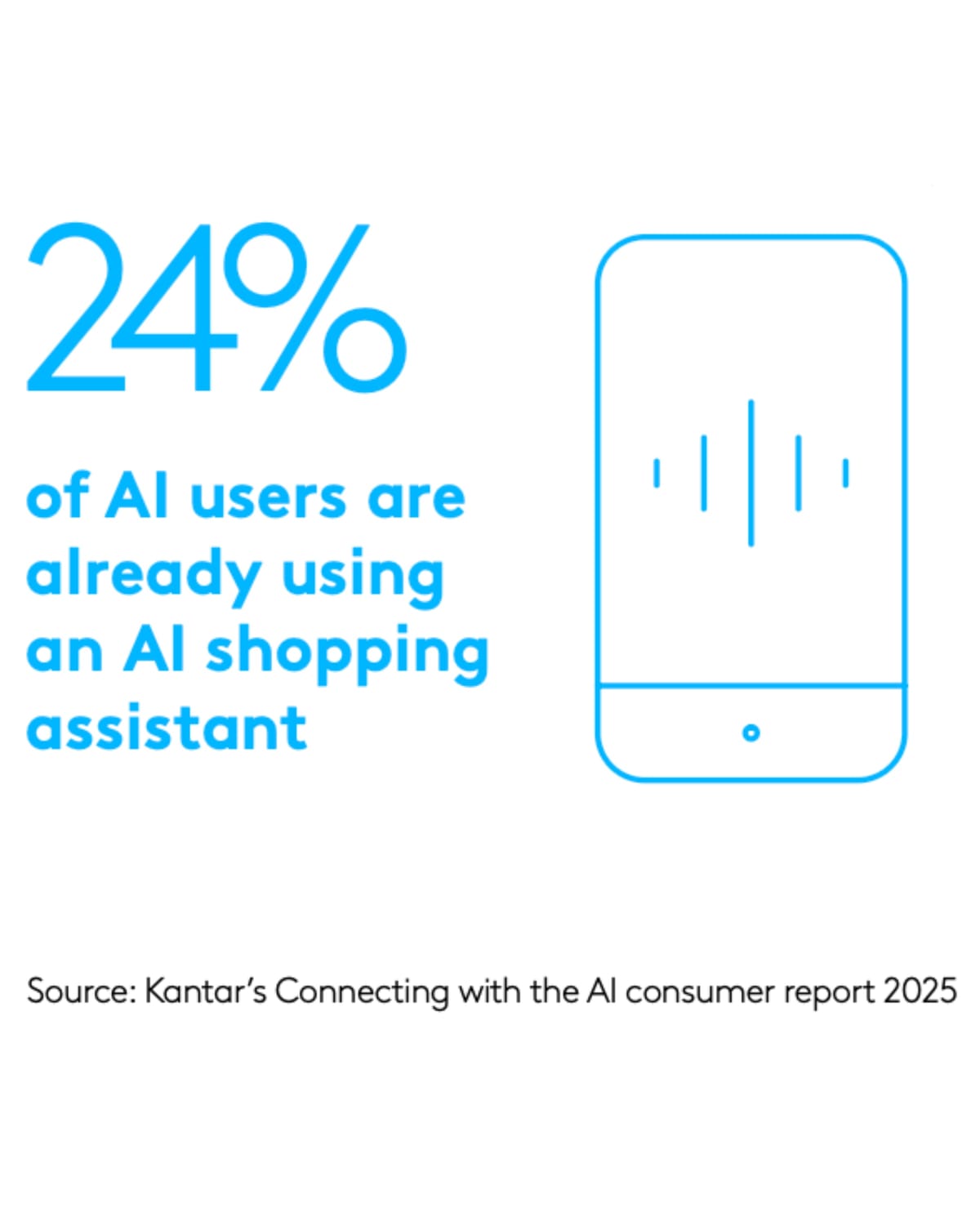
The research reveals 24% of AI users already deploy AI shopping assistants, according to Kantar's Connecting with the AI consumer report. This early adoption signals a fundamental change in how consumers make purchase decisions, as AI agents will increasingly brief themselves on behalf of users seeking mascara, entertainment services, or other products.
OpenAI's announcement that their new browser will incorporate AI agents marks a pivotal shift in consumer behavior. "As consumers, we will brief our own agents, expressing our intent for mascara or an entertainment service," according to the Kantar report. "And these agents will become more autonomous as cryptocurrencies are built in."
The implications extend beyond simple automation. Brands now face a dual challenge: predisposing both human consumers through traditional attention-seeking channels while simultaneously ensuring their products and services are discoverable by non-human agents. Product features, service details, guides, experiences and content will need to be widely findable across digital environments.
Kantar's Blueprint for Brand Growth proves that to grow, brands need to predispose more people. The framework now extends to predisposing agents as well. Brands that accelerate their AI visibility strategy in 2026 will be better positioned to drive growth, according to the research.
Purchase decisions will be increasingly mediated by Generative AI and agents who recommend brands and their content during 2026. Three-quarters of those who use AI assistants regularly seek out AI-driven recommendations, according to Kantar's Connecting with the AI consumer report.
The strongest brands will be those that shape the story AI is telling. Brands that fail to differentiate risk being lost in a sea of sameness - if you're not the default recommendation, you'll be optimized out.
Salience alone won't make brands algorithmically preferred. Enter Generative Engine Optimisation, the new SEO. GEO gets brands cited and trusted by large language models. If the model doesn't know you, it won't choose you, requiring brands to create clear, structured, machine-legible and relevant content.
Models must be primed with the meaning of brands and what they offer, including recipes and how-to content. This shift represents a fundamental change from traditional search engine optimization focused on keywords to content optimization focused on training AI recommendation systems.
The trend aligns with recent platform developments. Google launched a protocol for AI agents to shop across platforms in January 2026, while AI shopping adoption accelerated ahead of the holiday season with 85% of UK consumers planning AI-assisted shopping expressing willingness to trust autonomous agents. Amazon deployed generative and agentic AI across its shopping platform, reaching 250 million Rufus users.
However, skepticism has grown over AI shopping agents as analysts question commercial viability despite platform launches from major technology companies.
Augmenting audiences with AI will deepen marketers' understanding so they can strategize more effectively. Kantar's own synthetic data boosting delivers 94-95% accuracy versus the ground truth, according to the research.
Use of synthetic data requires a balance of speed, scale, and accuracy. However, algorithms vary significantly depending on the dataset and the scenario. As technologies like digital twins evolve, expect clearer guardrails and use cases, and the rapid integration of text, voice, image and virtual reality.
Generative AI will enhance how marketers visualize insights and integrate with large language model search. The industry isn't fully ready for this transformation. Responsible data, rigorous testing, new skills, and the technology and infrastructure to scale are musts.
Marketers are moving beyond synthetic hype to practical execution in 2026. Brands will need to develop internal capabilities, make informed trade-offs and work with trusted data partners to get ahead.
Jane Ostler, Chief Insights Officer at Kantar, emphasized the importance of data quality as the foundation for all ten trends identified in the research. "2025 has proved that Generative AI is about more than speed and efficiency," according to the report introduction. "Used wisely, it can help brands to understand people better and to make smarter decisions."
If you're one of the majority of marketers excited about Generative AI - 75% according to Kantar's Media Reactions survey - the next step is using it where it counts. For creative content, that means systematically adopting AI-powered evaluation techniques to predict which ads will capture attention, stir emotions, and affect purchase intent and long-term brand equity.
As AI-assisted testing becomes faster, more accurate and widely used, marketers will be able to test ads in real time. In 2026, agentic optimisation recommendations will give marketers the power to fine-tune campaigns dynamically, based on what's worked before, what's trending now and audience responses.
Human insight will be just as essential to tell brand stories authentically. There will be a focus on the quality of training datasets for the AI-based tools that make automated decisions, to ensure that the insights are robust and trustworthy.
Duncan Southgate, Global Creative and Media Lead at Kantar, stated that CMOs need to test and learn now, to ensure that creative effectiveness drives brand growth. The shift from creative optimization to creative intelligence requires systematic deployment of AI-powered tools while maintaining human oversight of strategic decisions.
Treatonomics, aka 'little treat culture', has emerged as an antidote to economic volatility and a fundamental change in life's milestones. With marriage, parenthood and home ownership increasingly out of reach or undesirable, treatonomics is about injecting optimism and control through small pleasures.
In fact, 36% of consumers are prepared to go into short-term debt to spend on things they enjoy, according to Kantar's Global MONITOR. People are now marking 'inchstones' just to have something to celebrate. It's the lipstick effect on steroids.
Social media's pivot to commerce, where demand is created and fulfilled in seconds, is keeping treatonomics alive. With economic uncertainty still ongoing, the trend will likely persist into 2026. But trends are moving faster, and are fragmenting by geographical and cultural niches, so brands need to work hard to stay at the front of the race.
Bia Bezamat, Associate Director for Consulting at Kantar, asked whether brands are meeting consumers where they are, by creating joy in the everyday. The consumer behavior shift reflects broader economic pressures and changing life priorities among younger demographics.
Innovation is a proven multiplier. Over the past 20 years, brands willing to disrupt themselves or their category created $6.6 trillion in value, according to Kantar's BrandZ research. The Apples, Amazons and Googles demonstrated how strategic risk-taking drives exponential growth.
Yet many businesses stumble when it's time to take a risk. With disruption all around us, playing safe can feel tempting - but it's at the expense of future growth.
In 2026, short-termism won't be enough. Brands that make experimentation their default will grow and shape the future. Smart risk-taking thrives in cultures where teams have permission to push boundaries, exploration is structured, and experimentation is rewarded.
Crucially, innovation must be brand-led, not tech-led, rooted in what a brand stands for and in consumer motivations and tensions. With the advent of widely used AI tools, CMOs face a new imperative: ensure innovation brings a brand's meaningful difference to life, rather than chasing technology.
Dr. Nicki Morley, Global Innovation Lead at Kantar, emphasized that the biggest risk is still not taking one. Brands that make experimentation their default in 2026 will grow and shape the future.
Inclusive marketing is expansive marketing. It's how brands grow - by reaching out and meaningfully engaging high-growth populations who've long been underserved or under-represented.
Despite recent efforts to undermine diversity, equity and inclusion, in 2026, future-forward brands will leave behind the performative messages of the past and strive for more effective solutions to consumer needs for access to products and services, as well as representation within businesses and in external messaging.
Nearly two-thirds of people value companies who promote diversity and inclusion, up from 59% in 2021, according to Kantar's Global MONITOR research covering 28 markets with more than 36,000 respondents aged 13 and above. The 65% figure represents a sustained increase in consumer expectations around inclusive business practices.
Predisposing more people pays off in growth. However, in a climate of backlash, brands must lead with certainty, being clear about the values they stand for, and showing action.
Valeria Piaggio, Global Leader of Kantar Inclusive Growth and Sustainable Transformation Practice, stated that marketers should double down on inclusive innovation, culturally fluent programmes, and authentic representation on both sides of the camera in 2026.
With over 200 Retail Media Networks and counting, the channel is becoming central to reaching shoppers online and in-store. This networked approach has given media owners unprecedented control and influence on purchase decisions at multiple stages.
RMNs are high-performing: 1.8 times better results than digital ads, and nearly 3 times better results for purchase intent, according to Kantar LIFT data. No wonder a net 38% of marketers plan to increase RMN investment in 2026, according to Kantar's Media Reactions survey.
The strong performance metrics should pressure media owners to provide advertisers with greater transparency and more straightforward ROI measurement. Look out for shoppable ads on connected television and streamers to go mainstream next year - a major moment in reshaping the way people discover, interact, and buy products.
Nicole Jones, Chief Media Commercial Lead at Kantar, stated that brands and retailers will need to collaborate closely in 2026 to create consumer-focused advertising, with success hinging on data integration from different retail touchpoints.
The retail media expansion aligns with broader industry trends. Retail media networks are projected to capture 20% of global ad revenue by 2030, representing approximately $300 billion in spending. Retail media and CTV are converging as shopping shifts to streaming, while sponsored products coverage climbed 7% as retailers shift to dynamic ad placement strategies.
Commerce media maturity lags across industries despite $1.3 trillion projected growth, with only 22% of retail networks classified as trailblazers according to Koddi research.
A net 61% of marketers plan to increase their investment in creator content in 2026, according to Kantar's Media Reactions survey. The pressure to show impact grows. Engagement, likes, and views aren't meaningful outcomes - for brands to predispose more people through creators, the important benchmarks in 2026 will be ROI and brand-building metrics.
Coherent, cross-channel ideas are 2.5 times more important to campaign success than a decade ago, according to Kantar LIFT+ database analysis. But only 27% of creator content ties strongly to the brand.
The fix is structural: 2026 needs a shift from isolated creator executions to long-term creative platforms, or clustered themes, that align brand and creator-led content. Creators are not actors - they do their own thing.
The skill for brands will be learning to cede control and to co-create. Over-direct and the spark dies; under-brief and the brand risks disappearing. CMOs must set clear guardrails for creator content, solidify and share success metrics, then let creators do what they do best - in ways that manifest the brand's meaningful difference.
Věra Šídlová, Global Thought Leader for Creative at Kantar, emphasized that creator partnerships require balancing creative freedom with brand consistency. The challenge reflects broader tensions between authentic content and commercial messaging.
The creator economy continues evolving rapidly. The creator economy shifted from digital to in-person experiences with 41% of social media users attending influencer events in 2025, while newsletter monetization shifted toward sponsorshipsas paid models plateau.
Algorithmic feeds reward generic, sales-heavy content. Organic reach for branded pages keeps sliding, making broad engagement less effective and more expensive. Faced with crowded and impersonal spaces, people are moving towards micro-communities where they talk and belong in more meaningful ways.
Here, authenticity and relevance drive more engagement than reach, and brands win by showing up with tangible value rather than promotion, and consistently and authentically engaging with people's interests. It's about building with audiences, often by collaborating with credible creators.
In China, where many social trends originate, brands using knowledge-sharing micro-community platforms achieved a 25% higher marketing ROI, according to Kantar LIFT ROI database analysis. Nearly 40% of consumers trust micro-community recommendations as much as personal ones, a strong sign of these networks' peer-to-peer credibility.
Chirantan Ray, Chief Operating Officer for Greater China at Kantar, stated that marketers will need to pay close attention to ROI through authentic engagement and organic advocacy in micro-communities during 2026.
The shift toward smaller, more engaged communities reflects broader platform dynamics. Where traditional social media prioritizes scale and virality, micro-communities emphasize depth of connection and shared interests among participants.
The ten trends identified by Kantar represent interconnected shifts rather than isolated developments. AI agents mediating purchases require brands to optimize for machine discovery while maintaining human connection. Retail media's expansion creates new high-performing inventory as traditional digital channels face effectiveness challenges.
Creator content's growth demands proof of ROI as budgets shift from experimental to core media planning. Synthetic data enables audience insights at scale while raising questions about data quality and responsible use.
The research arrives during what global forecasts characterize as creative destruction across advertising. Global ad spending hit $1.14 trillion as commerce overtakes TV for the first time, while marketers drown in data yet struggle to measure campaign impact with 86% unable to determine channel effectiveness.
The Kantar research provides a framework for navigating these challenges. According to the report, "our Kantar experts have identified ten trends - some emerging and others more established - and mapped out a point of view for the year ahead."
The trends span technology adoption, consumer behavior, measurement standards, and creative execution. Each includes specific data points drawn from Kantar's proprietary research databases covering brand equity, advertising effectiveness, and consumer attitudes across global markets.
For brands, the implications are clear: 2026 will require balancing AI optimization with human creativity, performance measurement with brand building, and platform fragmentation with unified strategies. The marketers who navigate these tensions successfully will position themselves for sustainable growth.
Who: Kantar, a global marketing data and analytics firm, released the Marketing Trends 2026 report. The research involved contributions from Jane Ostler (Chief Insights Officer), Mary Kyriakidi (Global Thought Leader, Brand), Cynthia Vega (Global AI & Analytics Director), Duncan Southgate (Global Creative and Media Lead), Bia Bezamat (Associate Director, Consulting), Dr. Nicki Morley (Global Innovation Lead), Valeria Piaggio (Global Leader, Kantar Inclusive Growth), Nicole Jones (Chief Media Commercial Lead), Věra Šídlová (Global Thought Leader, Creative), and Chirantan Ray (Chief Operating Officer, Greater China).
What: The report identifies ten marketing trends for 2026, including AI agents mediating purchase decisions (24% of AI users already using AI shopping assistants), brand building in algorithmic environments (74% of AI assistant users seek AI-driven recommendations), synthetic data adoption (94-95% accuracy versus ground truth), AI-powered creative optimization (75% of marketers excited about Generative AI), treatonomics consumer behavior (36% of consumers prepared for short-term debt to spend on things they enjoy), innovation as growth engine ($6.6 trillion value created by disruptive brands over 20 years), authentic inclusion driving growth (65% of people value companies promoting diversity and inclusion), retail media network expansion (1.8x better results than digital ads, nearly 3x better for purchase intent), creator content effectiveness (61% of marketers planning investment increases, only 27% of creator content ties strongly to brand), and micro-communities in social media (25% higher marketing ROI in China for knowledge-sharing platforms).
When: The research was released in fall 2025, drawing from studies conducted throughout 2024 and 2025. The trends apply to marketing operations during 2026, with some projections extending to 2030 (retail media capturing 20% of global advertising revenue representing $300 billion).
Where: The research applies to global marketing operations, with specific regional examples from China, the United States, and Europe. The trends affect digital advertising platforms, retail environments, social media networks, streaming services, and AI-powered systems worldwide. Research data comes from Kantar's Global MONITOR (28 markets, 36,000+ respondents aged 13+), Connecting with the AI consumer report, Media Reactions survey, LIFT database, LIFT+ database, LIFT ROI database, and BrandZ valuations.
Why: Marketers face rapid technological change, shifting consumer behaviors, economic uncertainty, and platform consolidation that require strategic adaptation. The report aims to help CMOs plan for brand growth with confidence by cutting through noise and prioritizing what matters. According to Kantar, 2025 proved that Generative AI is about more than speed and efficiency - when used wisely, it can help brands understand people better and make smarter decisions. Any digital transformation will need to be harnessed to drive brand growth and brand value rather than simply pursuing technological capabilities without strategic purpose.